
Arizona College of Osteopathic Medicine - AZCOM
Glendale, Arizona
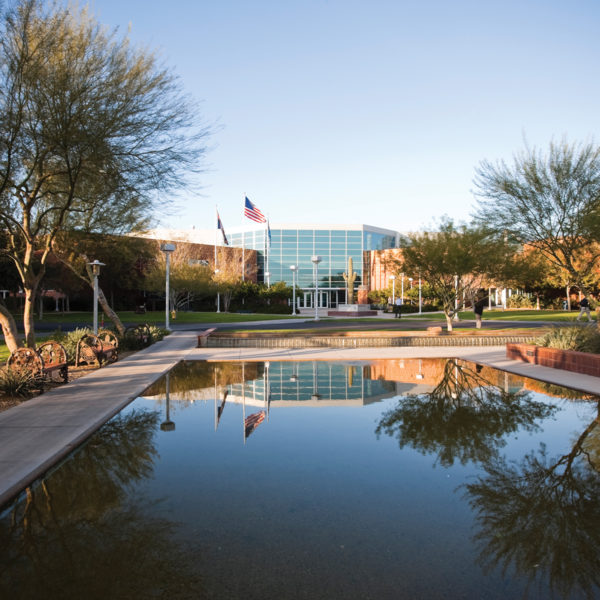
Main Campus
General Information
Midwestern University has a proud and impressive history. Founded in 1900 as the American College of Osteopathic Medicine and Surgery by J. Martin Littlejohn, PhD, DO, MD. (1865-1947), the organization was incorporated in Chicago, Illinois, to train physicians in a not-for-profit environment.
Today, Midwestern University is still governed by the strong principles of the founding administration and faculty. We are an independent, not-for-profit corporation organized primarily to provide graduate, and postgraduate education in the health sciences. We are dedicated to the education and development of our students, faculty, and staff in an environment that encourages learning and personal development.
Mission Statement
Closest City Phoenix, AZ
Campus Setting
SuburbanFacilities
Some of the facilities on campus include:
- Sahuaro Hall, with lecture halls, conference rooms, and laboratory classrooms boasting the finest in educational equipment and medical resources (64,850 sq ft).
- Cholla Hall, with two lecture auditoria, modern pharmacy laboratories, multi-use classrooms, and a computer lab (37,976 sq ft).
- Ocotillo Hall, with cutting-edge practice labs, classrooms, and a 600-seat dividable auditorium (40,000 sq ft).
- Agave Hall, with state-of-the-art anatomy and osteopathic manipulative medicine labs, as well as several multi-purpose spaces (40,000 sq ft).
- Glendale Hall, featuring classrooms, faculty offices, and a dental simulation lab (130,000 sq. ft.).
- Foothills Science Center, which houses faculty research facilities (26,765 sq ft).
- Mesquite Hall, home of the Clinical Skills & Simulation Center which offers human and technology-based simulation models for MWU students to practice clinical skills; features 19 clinical and 6 specialty exam rooms, a mock OR/ER, scrub room, and student testing/faculty observation areas with high-resolution video.
- 2,600-seat Auditorium with classroom space for lectures and large campus events (40,000 sq ft).
- Recreation & Wellness Hall, with gymnasium and exercise facilities, and special rooms for music, crafts, and dance/aerobics (26,135 sq ft).
- Four Barrel Student Center buildings, which are home to University departments including Admissions, Financial Aid, University Relations, Communications, Human Resources, Information Technology, Campus Security, and the Stagecoach Dining Hall.
- Student amenities include lounges, game room, and outdoor basketball courts and a sand volleyball court. Comprehensive medical library with computer resources and study rooms.
- Chanen Interfaith Chapel, with space for personal reflection, student organizations, special events.
- The Midwestern University Multispecialty Clinic, offering comprehensive family medical treatment in six specialty areas.
Student Residence Options
Student Apartment Complex
The apartment complex consists of studios and one- and two-bedroom apartments that feature ample study and living space; kitchen with range, oven, and refrigerator; wireless Internet; and cable television. The complex also has a swimming pool, volleyball court, sand play area for children, picnic and barbecue areas for residents and their guests.
COM Accreditation Status Midwestern University is accredited by the Higher Learning Commission (230 South LaSalle Street, Suite 7-500, Chicago, IL 60604-1413; 800/621-7440; www.higherlearningcommission.org).
University Affiliation(s) Midwestern University
-
2024-2025
Academic Year Enrollment
Total Medical School Enrollment
994
Total Male
523
Total Female
471
Total Other
0
First-Year Matriculants
265
First-Year Male Matriculants
137
First-Year Female Matriculants
128
First-Year Other Matriculants
0
Matriculants In-State
101
Matriculants Out-of-State
164
Self-Reported Race/Ethnicity
American Indian/Alaska Native
0%
Asian
29.1%
Black/African American
3.0%
Hispanic/Latino
12.5%
Native Hawaiian/Pacific Islander
1.1%
White
43.4%
Multiple Races
7.5%
Undisclosed
2.3%
Majors of First-Year Matriculants
Science Majors
91.3%
Non-Science Majors
8.7%
Graduate Degrees
8.7%
Overview
Private Institution
Non-Profit
Midwestern University
Institutional Affiliation
1995
Year Founded
Suburban
Campus Setting
Campus Contact
Arizona College of Osteopathic Medicine - AZCOM
Address
(623) 572-3275
Phone
Website
Admissions Office
Curricular Offerings
Instructional Program
As scientists and practitioners of the healing arts, osteopathic physicians subscribe to a philosophy that regards the body as an integrated whole with structure and function working interdependently. As an
extension of this philosophy, osteopathic physicians treat their patients as unique persons with biological, psychological, and sociological needs, an approach that underscores the osteopathic commitment to patient-oriented versus disease-oriented
healthcare. In recognition of this approach, Arizona College of Osteopathic Medicine (AZCOM) has developed, and continues to refine, a four-year curriculum that educates students in the biopsychosocial approach to patient care, as well as the basic
medical arts and sciences.
Within this curricular format, AZCOM students spend their first two years completing a rigorous basic science curriculum and preparing for their clinical studies, including early clinical simulated experiences. During their third and fourth years, students rotate through a variety of clinical training sites accruing 84 weeks of direct patient care experience. By stimulating intellectual curiosity and teaching problem-solving skills, the AZCOM curriculum encourages students to regard learning as a lifelong process.
Total Curricular Hours
First Year – 71.5
Second Year – 64.0
Elective Credits – 2.0
Third Year – 72.0
Fourth Year – 63.0
Total – 272.5
Our clinical curriculum is designed to give students broad, hands‑on experience across a wide range of medical specialties while preparing them for residency and future practice.
Third‑Year Clinical Rotations: During the third year, students participate in a series of 4‑week core rotations located at clinical sites throughout Arizona. These rotations provide foundational training across major medical disciplines, including:
- Family Medicine
- Internal Medicine
- Cardiology
- Obstetrics & Gynecology (OB/GYN)
- Pediatrics
- General Surgery
- Psychiatry
- Rural Medicine
These experiences help students build essential clinical skills, strengthen patient‑care competencies, and gain insight into various fields.
Fourth‑Year Rotations: In the fourth year, students tailor their education through advanced rotations across the United States. These include:
- Emergency Medicine
- Critical Care
- Advanced Surgical rotations
- Audition rotations designed to support residency placement
- Research rotations for students interested in scholarly work or academic medicine
This flexible, nationwide rotation model allows students to explore specialized interests, strengthen residency applications, and gain exposure to diverse healthcare systems.
Dual Degrees/Concurrent Programs Offered
Master of Public Health (MPH)
The Master of Public Health (MPH) program may be completed as a dual-degree over a four-year period. The program includes required and elective coursework; a planned, supervised, and evaluated public health practicum; and a culminating project.
Core courses are based on the five foundational public health knowledge domains of epidemiology, biostatistics, environmental health science, social and behavioral science, and health policy and management. Students also complete courses in a Global One Health concentration, with electives focused on each of the One Health domains of human, animal or pathogen, and environment.
Master of Science in Precision Medicine (MS)
Master of Science in Precision Medicine (M.S.) To better prepare our students for the rapidly evolving use of genomic data in healthcare fields, Midwestern University offers a fully online 2-year Master of Science in Precision Medicine (M.S.). This program has a flexible format that is designed to be completed as a dual degree in conjunction with another Midwestern healthcare professional degree.
If your goal is to develop foundational and applied knowledge of genomics and other cutting edge ‘omics technologies in order to better inform care of your future patients, this program will help you to achieve that. We will provide you with a broad education and the practical skills necessary to use precision medicine in daily patient care. You will finish this program with the capacity to understand and critically evaluate new data and techniques, so that you can best help your patients make informed healthcare decisions. This M.S. degree includes a culminating applied genomics capstone project that will allow students to use and showcase their precision medicine skills.
Premedical Coursework
Courses below are shown as either Recommended or Required and, when applicable, include the number of semester hours needed.
Anatomy
RecommendedBiochemistry
RecommendedBiology/Zoology
Required With Lab8 semester hours
Chemistry (Inorganic)
Required With Lab8 semester hours
Chemistry (Organic)
Required With Lab8 semester hours
Physics
Required With Lab8 semester hours
Physiology
RecommendedCollege English
Required6 semester hours
Admissions
AZCOM uses a rolling admissions process to review completed applications and make interview decisions. Applications will not be reviewed until all required application materials have been received by the Office of Admissions, including the AACOMAS application, official MCAT scores (as reported to AACOMAS), processing fee, and both required letters of recommendation. Students should complete their files as soon as possible to remain competitive in this process and to ensure full consideration of their application.
PLEASE NOTE: Applicants are responsible for tracking the receipt of their application materials and verifying the status of their required application materials on the university website. Instructions for accessing your application information on the University website will be sent to you by the Office of Admissions. Please keep the Office of Admissions informed of any changes to your mailing address and e-mail address. All requests for withdrawing an application must be done in writing. Applicants are expected to act professionally in their interactions with AACOMAS and with AZCOM. Please always follow AACOM’s applicant protocol.
Interview Options: Option to interview virtually or in-person
Physician letter required? MD or DO
Virtual Shadowing Options? Only in-person shadowing accepted
Accepts online coursework to fulfill prerequisite requirements? Yes
Accepts prerequisite coursework pass/fail grades? Yes, but only in certain circumstances
Science coursework (including labs) should be taken in-person whenever possible.Will your institution waive MCAT exam requirements? No
Accepts online lab coursework? Yes
Primary Application Service: AACOMAS
Earliest Application Submission Date: May 4, 2026
Primary Application Deadline: March 1, 2027
Submission Timing for Best Consideration
AZCOM uses a rolling admissions process in which applications are reviewed and interview decisions are made at each interval during the admissions cycle. Interviews are conducted and selection decisions for the College are made until the class is filled. Applicants are notified of their selection status within two to four weeks after their interview date.
To be competitive within this process, candidates should apply early in the admissions cycle. Within its competitive admissions framework, the College uses multiple criteria to select the most qualified candidates from an applicant pool that exceeds the number of seats available. AZCOM typically receives over 7,500 applications for its 250 seats.
First Year Class Matriculant's Selection Factors
Applicants must meet all the admissions requirements listed previously to be considered for on-campus interviews. After the Office of Admissions receives all of the required application materials, applicant files are reviewed to determine whether applicants merit interview invitations based on established criteria of the Admissions Committee. Applicants who are invited to interview will be contacted by the Office of Admissions and receive instructions for scheduling their interviews via the University’s web-based scheduling system. Additional applicants may be placed on an interview “Wait List” pending possible interview openings toward the end of the interview cycle.
When applicants accept interview appointments, they join other interviewees to meet with members of an interview panel selected from a volunteer group of basic scientists, current students, administrators, and clinicians. Panel members assess applicants for their academic and personal preparedness for medical school, and their understanding of the osteopathic physician’s role in the healthcare team. They rate applicants on a standardized evaluation form relative to each variable. At the conclusion of the interviews, the panel members forward their applicant evaluations to the Admissions Committee. The committee may recommend to accept, to deny,or to place the applicant on either the hold or alternate list. This recommendation is then forwarded to the Dean of AZCOM for final approval.
International Students Accepted? Accepts International Students
United States citizens and permanent residents who have met all prerequisites and technical standards are eligible to be considered for admission. A limited number of citizens of countries where osteopathic physicians can get full, unrestricted licenses—such as Australia and some Canadian provinces—may apply to AZCOM if they meet all prerequisites and technical standards.
Applicants from other countries must show proof that they can obtain the necessary licensure for visa purposes during postgraduate training and must remain in good standing with the State Department for participation in osteopathic medical training throughout the AZCOM curriculum.
Are Deferred Action for Childhood Arrival (DACA) students considered for admissions? Yes
Application Interview Format: Traditional
Early Decision Program (EDP)
EDP Offered? No
EDP Applications Submitted To AACOMAS
Supplemental Application
Supplemental Application Required? No
Supplemental Application Sent To: N/A
Supplemental Application Fee: N/A
Supplemental Application Fee Refundable? No
Supplemental Application Fee Waiver Available? No
Orientation/Start Date for First Year Students
August 4, 2027
Deferred Entrance Requests Considered? Yes
Medical related deferments will be considered on a case-by-case basis.Acceptance/deposit deadlines conform to the AACOMAS Traffic Guidelines Schedule? Yes
Osteopathic Medical College (COM) applicants may be asked to submit necessary matriculation documents, including a deposit, according to the following AACOMAS traffic guideline schedule:
- Those accepted prior to November 15 to have until December 14.
- Those accepted between November 15 and January 14 to have 30 days.
- Those accepted between January 15 and April 30 to have 14 days.
- Those accepted on or after May 1 may be asked by the accepting COM for an immediate deposit.
- After May 1 of the year of matriculation, each COM has the discretion to implement COM-specific procedures for accepted students who hold one or more seats at other COMs.
Mean MCAT Score
504.1
Avg. Cum. Undergrad GPA Score
3.62
Oldest MCAT Considered: August 1, 2024
Latest MCAT Score Accepted: June 1, 2027
Accepted Sources for Letters of Recommendation
- AACOMAS
- Interfolio
- Paper
Main Admissions Contact
Tuition, Fees & Financial Aid
2026-2027 Academic Year
In-State Tuition
$80,656 (2026 TBA)
Out-of-State Tuition
$80,656 (2026 TBA)
Annual Fees
In-State Resident Fees
$750 (2026 TBA)
Out-of-State Resident Fees
$750 (2026 TBA)
Health Insurance Fee
$3,738 (2026 TBA)
Tuition Fees Include
Estimates, Deposits, and More
Estimated Annual Room Board, Books, and Living Costs
$27,561
Average Graduate Indebtedness
$315,873
Acceptance Deposit
$1,000
Additional Deposit
$0
Deposit Applied to Tuition? Yes
Deposit Refundable? Yes
Partially. NOTE- the text provided is too long. The text for this question must be less than 255 characters.Financial Aid Website https://www.midwestern.edu/admissions/paying-college/financial-aid
Percent of Enrolled Students with Financial Aid TBA%
Scholarships Offered? Yes
Annual Scholarship/Grant Per Student: $TBA