
Student Financial Aid Resources
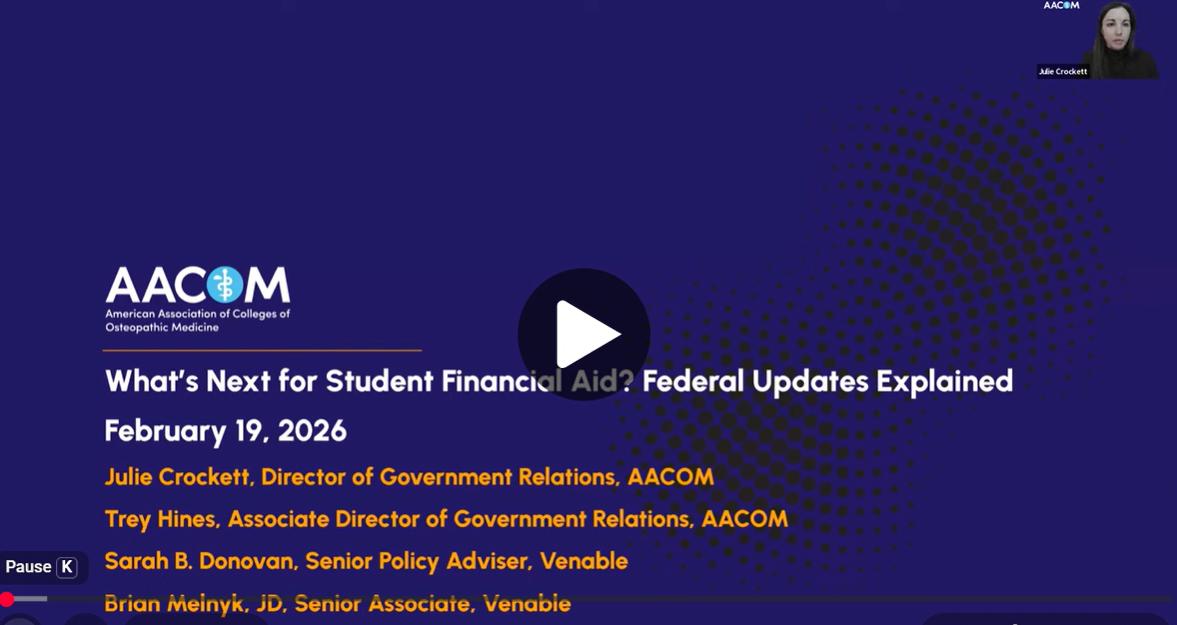
Since enactment of the One Big Beautiful Bill Act (OBBBA) (P.L. 119-21) in July 2025, the federal student loan system has experienced significant policy shifts with direct implications for medical students, residents and educational institutions. These changes have restructured the processes governing loan origination, repayment and federal oversight. Over the past year, reforms have narrowed borrower protections, revised repayment frameworks, and expanded institutional accountability for student debt outcomes.
As these policy changes unfold, AACOM will continue to monitor developments, advocate for osteopathic medical students and provide clear, accessible updates to help our community stay informed about evolving federal student loan policies.
Resources
- Department of Education Negotiated Rulemaking
- ED Resources
- AACOM Resources & Analysis
- One Big Beautiful Bill
Student Borrowing Changes
The OBBBA eliminated the Grad PLUS loan program and instituted new federal student loan borrowing caps that go into effect on July 1, 2026. These caps depend on the type of education a student is pursuing. For graduate degree programs, loans will be limited to a $20,500 annual borrowing maximum and a $100,000 lifetime limit. For professional degree programs, the annual loan cap is $50,000 annually with a $200,000 lifetime limit.
Importantly, any borrowing used for a graduate program counts toward the lifetime limit for a subsequent professional degree.

Currently, the following ten degrees will be considered “professional” and allowed higher loan caps for the following programs:
- Doctor of Osteopathic Medicine (D.O.)
- Doctor of Medicine (M.D.)
- Juris Doctor (J.D.)
- Doctor of Dental Surgery (D.D.S.)/Medicine (D.M.D.)
- Doctor of Pharmacy (Pharm.D.)
- Doctor of Veterinary Medicine (D.V.M.)
- Doctor of Optometry (O.D.)
- Doctor of Podiatric Medicine (D.P.M.)
- Doctor of Chiropractic (D.C.)
- Master of Divinity (M.Div.)
- Clinical Psychology (Psy.D.)
To learn more about the “professional degree” discussion, click here.
In practice, the impacts of these loans' regulations vary depending on a student’s need and educational history.

Institutional Accountability
To maintain eligibility for Title IV student loans, programs must demonstrate that their programs do not leave students financially worse off than when they enrolled. To assess this standard, the OBBBA created an “earnings premium measure” that compares the earnings of program graduates four years after completion against a specific cohort of earners. For DO-granting programs, graduate earnings will be measured against those of working bachelor’s degree holders ages 25–34 who are not enrolled in postsecondary education. The first earnings premium calculations under the new rule will be released by July 1, 2027. Programs that fail the earnings premium measure in two out of three consecutive years will lose eligibility to participate in the Direct Loan program for a minimum of two years.
For more information on the earnings premium measure, see AACOM’s analysis and a summary from the National Association of Student Financial Aid Administrators.
What’s Next?
In 2025, the U.S. Department of Education (ED) convened two Negotiated Rulemaking (neg-reg) committees to implement the student loan reforms enacted under OBBBA.
The Reimagining and Improving Student Education (RISE) negotiated rulemaking committee was tasked with implementing the new federal student loan caps, the repeal of the Grad PLUS loan program, and related changes to student lending policy. The committee reached consensus in November 2025. On January 30, 2026, ED released its Notice of Proposed Rulemaking (NPRM) reflecting that consensus language and accepted comments until March 2, 2026, which AACOM submitted. On Friday, May 1, 2026, ED issued its final rule after reviewing submitted comments, which is expected to take effect July 1, 2026. For more information on the final rule, read ED's press release and fact sheet.
The Accountability in Higher Education and Access through Demand-Driven Workforce Pell (AHEAD) neg-reg committee met in December 2025 and January 2026 to implement the institutional accountability metrics along with establishing a new Workforce Pell grant program. The committee reached consensus, and ED released a proposed rule on March 9, 2026. A public comment period will run through April 8, 2026, before a final rule is issued, with implementation anticipated July 1, 2026.