Healing and Heritage in Oklahoma
Published February 09, 2026
Impact Gallery Images Impact Stories Impact Stories Report Page
In the foothills of the Ozark Mountains in Tahlequah, Oklahoma, alongside the picturesque views, you’ll find the only tribally-affiliated medical school in the country—Oklahoma State University College of Osteopathic Medicine at the Cherokee Nation (OSU-COM at the Cherokee Nation).
When Mackenzee Thompson, DO, first arrived at OSU-COM at the Cherokee Nation, she knew she’d receive the rigorous, holistic and culturally competent medical education that initially drew her to medicine. “I felt like osteopathic medicine was the best way to train myself to take care of my patients,” she said, reflecting on her hopes of improving health in rural Oklahoma, similar to her small hometown.
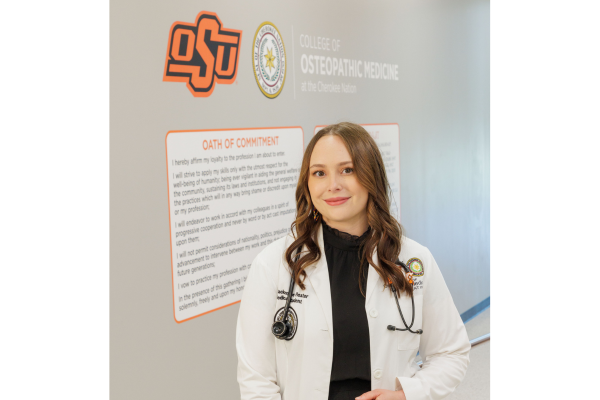
Mackenzee Thompson, DO. Photo Courtesy of Oklahoma State University.
She didn’t realize how her medical training would also become an opportunity to reconnect with her Native American culture and help engage other young people to pursue careers in medicine.
Growing up, Mackenzee didn’t have a deep connection to her Choctaw heritage and culture. When she became one of nine Native American students in OSU-COM at the Cherokee Nation’s inaugural class of 46 graduates in 2024, she found similar experiences brought her and her Native peers to medicine and shaped how they viewed health and well-being. This strengthened not only her identity as a physician, but as a Native American physician.
“Coming to Cherokee Nation, I've been able to learn so much more about [other] Native American culture[s] and my own heritage from my fellow medical students and colleagues. I didn't feel like I had that connection before,” shared Mackenzee about being part of a tribal medical student community.
To further explore the intersection of culture and medical competency, she pursued the Tribal Medical Track, to learn how to tangibly improve health in tribal, rural and underserved Oklahoma communities.
“Learning and practicing osteopathic medicine in a tribal facility has been really cool. In Oklahoma, tribal areas are often also rural areas, so as a physician you need to know how barriers related to those communities go hand in hand. You start to see how social determinants of health come up in care. You know it's not only just the person, but also how they are within their culture and their environment and their community,” Mackenzee said.
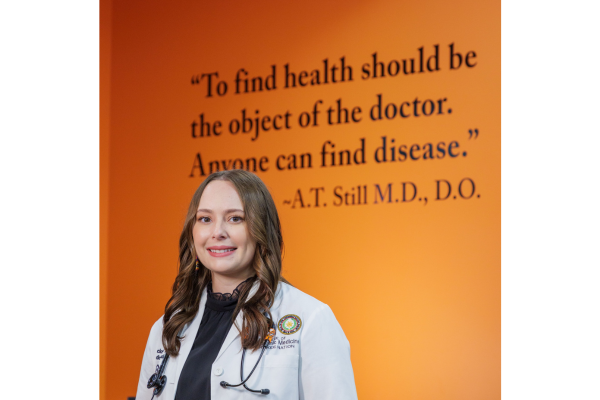
Mackenzee posing in front of an A.T. Still quote. Photo Courtesy of Oklahoma State University.
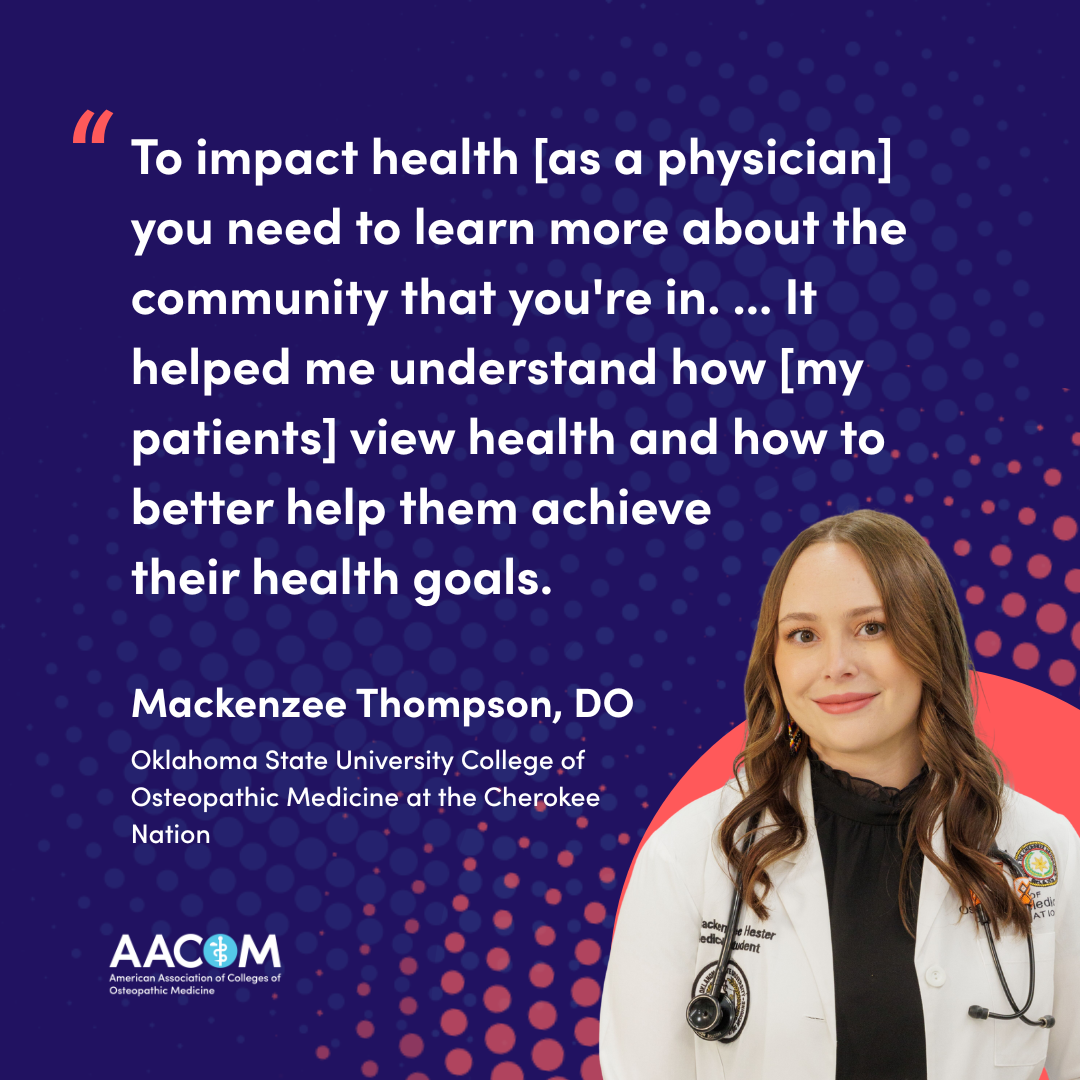
For Mackenzee, true impact on health begins with understanding and serving the community. “To impact health [as a physician] you need to learn more about the community that you're in. As a Tribal Medical Track student, I had the opportunity to learn about the traditional ways of gardening, medicinal practices, Native American beliefs around community and nature. It helped me understand how [my patients] view health and how to better help them achieve their health goals.”
By training physicians to understand the individual and care for the unique needs of every patient, OSU-COM at the Cherokee Nation creates better outcomes for all Oklahomans, of all backgrounds.
The decades-long partnership between OSU and the Cherokee Nation started with medical student rotations and blossomed into a collaborative vision for improving rural and tribal healthcare. Having experienced the health needs of both communities, Mackenzee shared, “It's really awesome to have that partnership between our academic institution and a sovereign nation, where both groups are investing in the future of our communities.”
Recently, the partnership between OSU-COM and the Cherokee Nation received High Honors from the Harvard Kennedy School Project on Indigenous Governance and Development’s Honoring Nations Awards. The honor recognizes the innovative, sovereignty-driven approach OSU-COM at the Cherokee Nation takes to improve access to medical care for tribal citizens, building a pipeline of future physicians and transforming health outcomes for future generations.
Through the many engagement opportunities created from the partnership, Mackenzee and her OSU-COM peers have become integral members of the Tahlequah community. “OSU did a really great job of building trust here over 10 years and created a strong foundation,” shared Mackenzee. Throughout her medical education, she continued building her own bonds in the community by spending time in Tahlequah, volunteering and completing her rotations. “You start to really get to know people, get involved in the community,” Mackenzee said.
Mentorship became a valuable and memorable aspect of Mackenzee’s community engagement. As an Ambassador Coordinator, she helped organize learning opportunities for young people in the community to develop their interest in medical careers. Particularly rewarding, was facilitating the Native American Pre-Admissions Workshop, which pairs medical students with pre-med Native American students for guidance and resources during a one-day workshop. “[As the first physician in my family] I didn’t have others in my family to ask for help. [Becoming a mentor] is definitely one of my favorite things about this journey. Going through [medical school], but then also just helping the people after me do the same.”
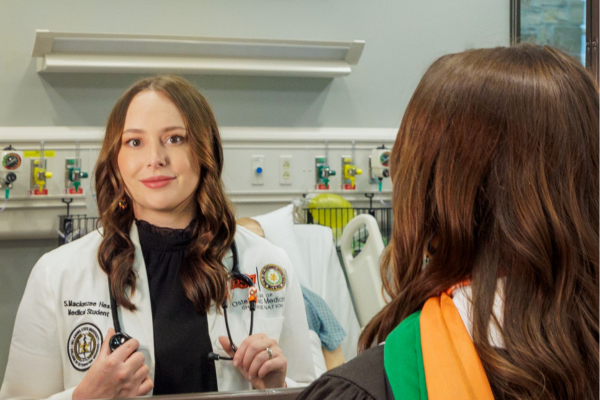
Photo Courtesy of Oklahoma State University.
Importantly, these recruitment events build the pipeline of physicians that learn, grow and practice in Oklahoma, says Mackenzee. “We are helping people in rural and tribal Oklahoma to become doctors and then come back to practice in their own communities,” she added.
That pathway mirrors Mackenzee’s own journey. She’s completing a residency in family medicine across the street from OSU-COM at the Cherokee Nation. “I love family medicine because you really get to know your patients the longer you work with them. I want to grow with them in their lives and be there for [all the milestones], kids, grandkids. I do plan to go back to central Oklahoma and see myself practicing in an outpatient clinic and offering osteopathic manipulative treatment in addition to primary care.”
As she continues to serve and lead, Mackenzee’s path showcases the vital strides that OSU-COM at the Cherokee Nation has taken to produce physicians who embody service, compassion and cultural competence to shape healthier communities.
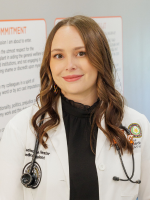 Dr. Mackenzee Thompson, DO, is a member of the Choctaw Nation and family medicine resident in Oklahoma, who is dedicated to improving health outcomes for Native Americans.
Spread the word!
Mackenzee Thompson, DO, found community and purpose through her osteopathic medical education at OSU-COM at the Cherokee Nation—see how culture and care inspired her to pursue family medicine and aim to improve health in Oklahoma’s rural and tribal communities.
As a physician, it’s important to understand the rich cultural history of the communities you serve, shares Mackenzee Thompson, DO. In a new feature story, she shares how cultural competence helps advance better health outcomes for the rural and tribal communities she serves in Oklahoma.