
Charting New Pathways: How a DO‑PhD Student Is Expanding Osteopathic‑Aligned Cancer Research
Published April 20, 2026
Research Stories Research Stories Report Page
When Tanner Wetzel, BS, MPH, PhD, DO'27, decided to pursue osteopathic medicine, he thought his future career would resemble his previous experiences caring for patients with dementia at a local nursing home: listening to his patients’ stories and building a personal connection to help them live healthy lives filled with meaning. It wasn’t until he arrived at Des Moines University College of Osteopathic Medicine (DMU-COM) and learned about the newly instituted DO-PhD pathway program, designed to develop physician-scientists who both deliver high-quality patient care and generate innovative solutions to improve health outcomes, that he imagined another possibility.
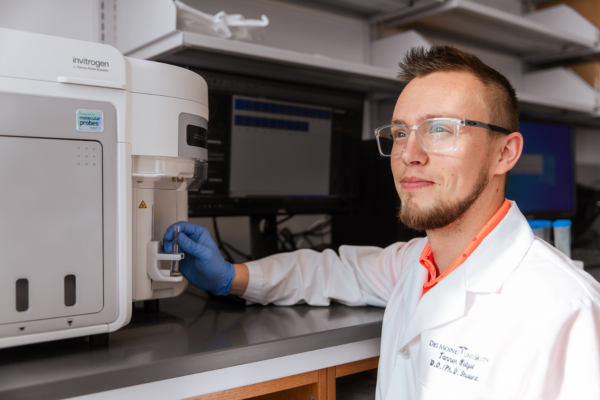
Tanner Wetzel working a flow cytometer to categorize different cells
“Research has been a focus of mine, a big part of my life. It was really important for me to continue that on through medical school. And when the opportunity arose to join in on the DO-PhD program, I jumped at the chance,” Tanner shared.
“We see highly motivated medical students, like Tanner, seeking academic research opportunities, and we have driven mentors doing research and educating our students. [DMU-COM] saw a very clear opportunity to strengthen the pipeline of osteopathic physician scientists and build the DO-PhD pathway,” said LiLian Yuan, PhD, interim program director of the DO-PhD program and professor of physiology and pharmacology at DMU-COM.
“There’s a lot of opportunities and room for our DOs to bring their perspectives to scientific research, to deliver excellent patient care and generate new knowledge that can [potentially] improve health outcomes,” Dr. Yuan continued. “There’s another wonderful addition; our school supports this [program] by providing financial support to make this pathway feasible, and I think that is very important,” she shared.
During his undergraduate education, Tanner studied biotechnology at South Dakota State University and conducted research on biofuel under Ruanbao Zhou, PhD. At the same time, he completed a competitive research internship at the University of Nebraska Medical Center with Todd Wyatt, PhD, where he examined how substances, such as alcohol and nicotine, affect lung immune systems across different populations.
Tanner explained, “When nicotine combusts and alcohol metabolizes, some of the molecules will combine and stick to different proteins in the lungs. It’s been shown that individuals with substance use disorders have a higher incidence rate of pneumonias, so we were looking for immunological relevance of those sticky molecules on surfactant proteins.”
That work continued during his master’s degree studies in public health, where he examined the combined effects of alcohol and nicotine use—particularly through electronic cigarettes—on pulmonary immunity.
At DMU-COM, Tanner expanded his focus again, working with Daniel Christian, PhD, associate professor of physiology and pharmacology, to study how chronic alcohol withdrawal alters synaptic signaling in the brain, changes that may contribute to anxiety and relapse.
“My background has given me a unique perspective with transitioning from biofuel research to substance abuse research and now investigating cancer. I've learned how to apply a broad spectrum of ideas,” Tanner reflected.
For Tanner, the connection between research and clinical practice is unmistakable. He describes patient care and scientific inquiry as parallel processes: each involves gathering data, forming hypotheses and testing solutions. “Medical students are often trained to recognize patterns or buzzwords, but real patients don’t always fit into neat categories,” he explains. “Research sharpens your problem‑solving skills and teaches you to ask better questions. That’s essential for any future physician.”
“Whether you’re working in a lab or at the bedside, people want to feel heard,” Tanner continued. “Research gives us the tools to help them—not just with treatments, but by understanding the biology behind what they’re experiencing. That’s what keeps me going,” he shared.
Today, Tanner’s research still centers his interest in immunology but has shifted toward understanding cancer cells and enabling protective immune responses, merging his long‑standing passion for biomedical research with his osteopathic medical education.
“My PhD research focused on how we can change or modify the immune system to help it do its job better, and that thinking directly relates back to osteopathic medicine and belief in the body’s innate ability to heal itself. We're able to apply that same philosophy to more of a research-type question and look at this global issue from a different perspective,” Tanner said.
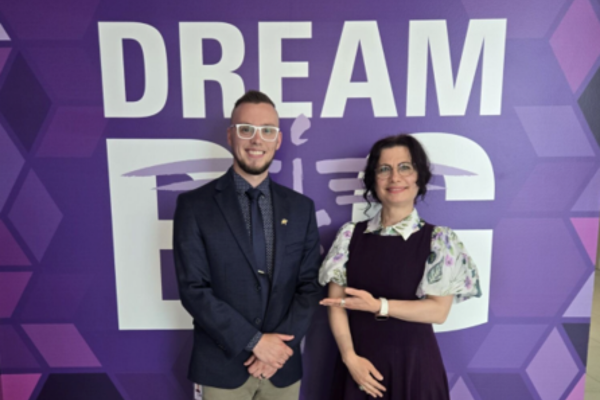
Tanner Wetzel and his PhD advisor, Dr. Elitsa Ananieva-Stoyanova
Under the mentorship of Elitsa Ananieva-Stoyanova, PhD, associate professor of biochemistry and nutrition at DMU, Tanner is looking to understanding the amino acid balance within the tumor microenvironment and how T cells, an immune system-supporting type of white blood cell that protects against disease, require some of these amino acids to function. Tanner explained that T cells are on the front lines of fighting cancer cells, and the current immunotherapy treatments are less effective when T cells fatigue. “Our goal for this project was to understand how amino acid support can boost T cell function and strengthen the body’s ability to fight cancer in patients receiving immunotherapy,” he shared.
Through the DO‑PhD dual degree, Tanner is preparing not only to address the root causes of illness when treating his patients but also to shape the evidence that guides care. “This program has really opened up space for applying osteopathic philosophy in new directions,” he said. “We’re trained to see interconnected systems and think holistically [as physicians]. That’s exactly what good research requires.”
As the first student to participate in this pathway program, Tanner credits DMU-COM’s supportive environment for his progress and helping him navigate unknowns. Through the small cohort size, he has the opportunity to work directly with his principal investigator in the lab; something he notes is rare in biomedical PhD training.
“It’s a huge strength,” Tanner said. “I get one‑on‑one mentorship every day, which accelerates [my] development as both a scientist and a future clinician.”
Only two candidates are accepted to the program each year. Dr. Yuan explained, “Our goal is to make DMU a place where physician-scientists feel welcomed and supported. With our small cohorts, students have direct access to faculty and a collaborative community that helps them grow.”
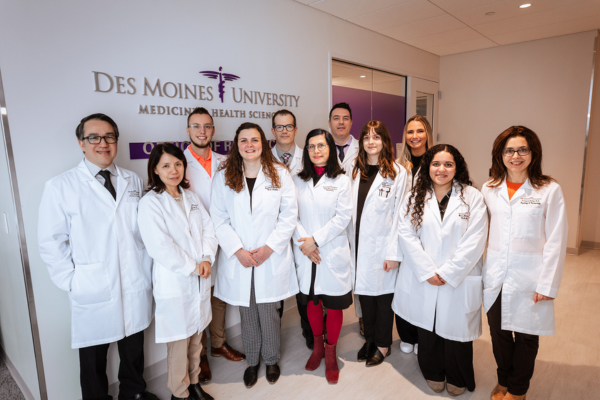
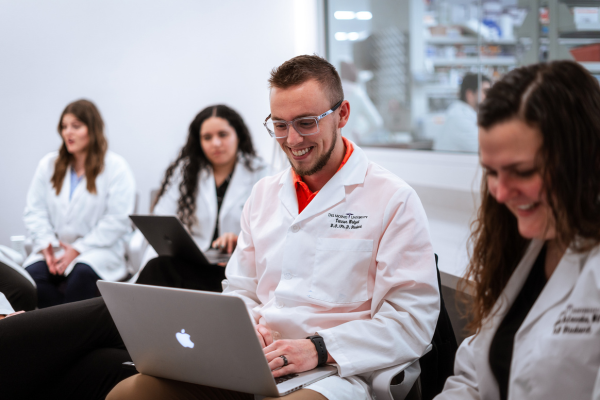
Tanner alongside peers across PhD programs at DMU
Tapping into the expertise of researchers who specialize in niche areas that intersect with his work is also possible through a close community of faculty and students in PhD programs across fields, Tanner shared.
Across PhD programs, students and researchers share the same lab. This proximity adds a huge value for partnership. As Dr. Yuan describes, “Our community is very collaborative. We share equipment and we share space. A lot of research ideas float around, and their half-life is very short. Spontaneous interactions help turn those ideas into viable projects.” Caption: Dr. Ananieva-Stoyanova, Tanner and Dr. Tran pose at commencement.
Looking ahead, Tanner hopes to complete a urology residency with the goal of pursuing a urologic oncology fellowship. This pathway will allow Tanner to provide cutting-edge medical management and surgical intervention for patients and apply his passion for research to advance the understanding of immunologic influence in the field. He has already begun analyzing the genetic drivers and regulators of prostate cancer and helped a local community health system conduct quality control reviews to enhance the detection of prostate cancer.
Tanner is eager to continue forging paths for himself and other DO-PhD students looking to play a stronger role in academic medicine. “This will give me the ability to train as an osteopathic physician scientist as well as a surgeon and use my research to improve outcomes for patients with urologic cancers. We need more osteopathic voices in research, and I’m excited to be a part of that momentum,” he said.
Tanner Wetzel is a third-year osteopathic medical student at Des Moines University College of Osteopathic Medicine. He earned his Bachelor of Science in Biotechnology from South Dakota State University, his Master of Public Health degree at the University of Nebraska and most recently completed his Interdisciplinary PhD in Biomedical Sciences at Des Moines University Medicine and Health Sciences.
Dr. LiLian Yuan, PhD, is a neuroscientist with more than 20 years of experience as an independent researcher and faculty member. Her integrates behavioral analysis, sex differences, neuroendocrinology and multi-omics approaches to elucidate mechanisms that motivate physical activity and promote brain and systemic resilience, aligning closely with NIH priorities in women’s health, aging and precision lifestyle interventions. She has served as PI on multiple NIH awards (R01, R03, R21 and R15), as well as foundational grants from the American Heart Association and the Whitehall Foundation. Across her faculty appointments, she has mentored more than 70 trainees and students at all levels, including postdoctoral fellows, PhD and MS students, undergraduates and medical students, with extensive experience directing dissertations and theses and supporting career development.
Spread the word!
- What does it mean to practice research as an osteopathic physician? For DMU‑COM student Tanner Wetzel, it means asking better questions, strengthening patient care and advancing cancer research grounded in holistic thinking. Check out his perspective in a new feature story.
- Research and patient care aren’t separate paths—they’re parallel ones. Hear from Tanner Wetzel, the first osteopathic medical student to pursue the DO-PhD pathway program at DMU-COM and how he hopes to support evidence that improves outcomes and advances whole‑person care.
- “Whether you’re working in a lab or at the bedside, people want to feel heard. Research gives us the tools to help them—not just with treatments, but by understanding the biology behind what they’re experiencing,” shares Tanner Wetzel, BS, MPH, PhD reflecting on the value of conducting research as an osteopathic physician. Check out his perspective in a new feature story.
- For Tanner Wetzel, conducting research as an osteopathic medical student allows him to enhance his patient care. Explore Tanner’s perspective as the first student in DMU-COM's DO-PhD pathway program and how his osteopathic lens is helping him advance innovative cancer treatments.