Genes as Medicine: Advancing a New Era of Osteopathic Innovation
Published April 20, 2026
Research Stories Research Stories Report Page
The promise of better health for his patients and hope for their families has always underpinned the work of physician and researcher Andrea Amalfitano, DO, PhD. Dr. Amalfitano studies acquired and genetic, often rare, diseases at Michigan State University College of Osteopathic Medicine (MSU-COM) to develop gene and immune-based therapies, allowing his patients to live longer, healthier lives.
He knew from a young age that his path intersected both clinical practice and cutting-edge innovation, which led him to become one of the first graduates of MSU-COM's DO-PhD pathway program.
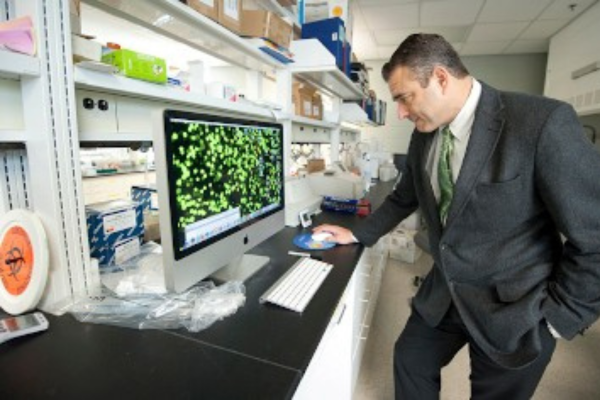
Dr. Amalfitano examining genetically engineered cells in his laboratory at MSU-COM
“Being able to combine clinical practice with research was always the dream,” Dr. Amalfitano reflects. “I became very interested in molecular biology, as it was emerging as a potential to treat human disease. While completing my residency, I became aware of the American Board Medical Specialty of Clinical Medical Genetics. It was a perfect fit for where my interests lie: seeing patients with genetic diseases or issues and using my research to better the condition.”
Pursuing his interests led Dr. Amalfitano to become one of only a handful of board-certified DO clinical geneticists today, a career path that allows him to shape evidence-based care for patients even beyond his clinical practice.
Advancing Gene Therapy and Tackling Rare Diseases
Dr. Amalfitano’s early work at Duke University Medical Center on Pompe Disease (a genetic condition resulting from a deficiency of enzymes that break up complex sugars, leading them to build up in other cells) generated the breakthrough FDA-approved enzyme replacement therapy, Myozyme.
Reflecting on the impact of that achievement, Dr. Amalfitano shared how after years of research and development, he provided the first child with the first infusion of Myozyme and recognized how physicians across the globe would soon be prescribing it as well.
“Because I see patients every day, in order to invest in an [research] effort, I have to see the translational outcome. That's really helped me find problems to investigate that I find interesting. It’s about bringing innovation back to the bedside,” Dr. Amalfitano shared. By grounding his research in patient-centered care, he ensures his work remains relevant to those he serves.
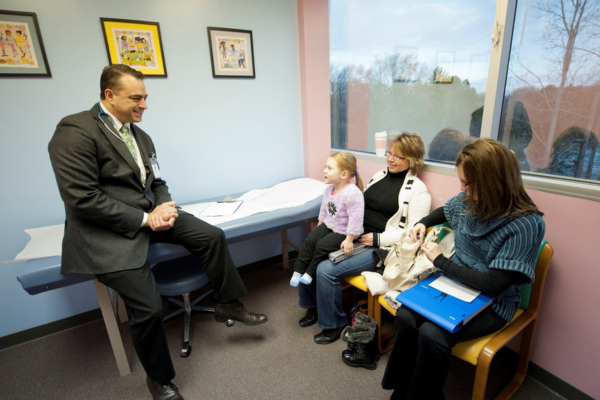
Dr. Amalfitano with a pediatric patient and family
Today, Dr. Amalfitano's lab at MSU-COM leads research seeking to reengineer viruses as safe, effective vehicles for gene medicines. Using this technology, his team is working on addressing cancers, genetic disorders and even infectious diseases like HIV and COVID-19. The lab also investigates specific gene changes that increase autoimmune disease risk to uncover new therapeutic targets based on their learnings.
Explaining the technologies and other research efforts, he shared, "We're trying to design therapies that stimulate the body’s own immune system to fight disease.” Behind Dr. Amalfitano’s approach lies a core concept of the osteopathic philosophy: the body’s self-healing capabilities.
“It certainly is thrilling to think about the fact that we can use genes as medicine, to stimulate the body's own immune system to fight back, rather than [other] therapies, which can have a lot of side effects. It's basically taking the immune system and attempting to modulate it to get someone back to baseline. It truly is fascinating that you can manipulate a system like the immune system to affect a lot of potential diseases,” Dr. Amalfitano shared, noting the osteopathic nature of his research.
Advancing Osteopathic Research and Patient Care
Dr. Amalfitano’s work—and the broader growth of osteopathic-aligned research—has been powerfully supported by the Osteopathic Heritage Foundation (OHF). The OHF Endowed Professorship in support of the Center for Neuromusculoskeletal Research at MSU-COM enabled Dr. Amalfitano to return to his alma mater, supplied critical resources for his lab and allowed him to build a successful environment for future physician scientists.
“The OHF’s support is a testament to their dedication to seeing our profession not only survive but [also] prosper and innovate. They continue to bring resources to retain faculty and researchers that benefit the [COM]. So, I hope I fulfill that for them,” Dr. Amalfitano notes.
“I've benefited tremendously. My students have as well, because I’ve taken many of the resources to support future DO-PhD students in my lab. I think I’ve mentored and graduated five or six DO-PhDs, all of them supported by the OHF funds in some capacity,” he continued.
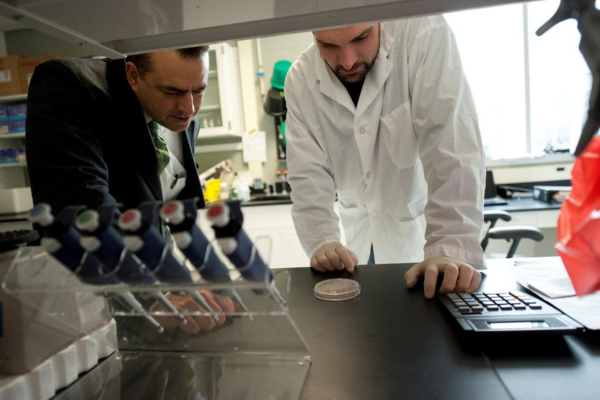
Dr. Amalfitano in the lab with a student
As a strong supporter of early research experiences for medical students, Dr. Amalfitano often speaks with all his students about the role science plays in enriching medical education and enhancing practice. He champions curiosity and investigative thinking among students and residents, urging them to view research as a natural extension of the inquisitiveness that brought them to medicine in the first place.
"You’re programmed to be curious as a physician; why your patients are coming to see you and about their histories. As an osteopathic physician, you’re taking a holistic approach to understand their psycho-social dynamics. You want to pull this all together, so you can have the best answer for whatever questions might come up in your doctor-patient relationship. Well, that's investigation; that is sleuthing. Research is sleuthing—it’s the same mindset you use as a clinician,” he tells his students.
Fostering inquiry, Dr. Amalfitano said, equips future osteopathic physicians with the ability to understand the underlying evidence that shapes patient care. It helps physicians interpret medical literature, communicate complex information to patients, discover new options to improve and align holistic care and can spark a passion for scientific investigation. A
Vision for Community-Based Medical Research
Dozens of undergraduates, PhD and DO-PhD students as well as residents and fellows have trained in Dr. Amalfitano’s lab. Many have gone on to blend research with patient engagement in their own careers, strengthening the field for generations to come and contributing to the cycle of evidence-based practice in osteopathic medicine.
For Dr. Amalfitano, the increase in DO physician scientists represents new opportunities for osteopathic-aligned research that highlights the profession's strengths: holistic philosophy, strong ties to primary care and deep community engagement. He believes these attributes uniquely position the profession to tackle some of medicine’s most pressing challenges.
Through the community-based training model osteopathic medicine employs, Dr. Amalfitano explained the huge opportunities that exist to study novel interventions, reduce health disparities and meaningfully increase population health. These opportunities may not be feasible in typical, large academic medical centers.
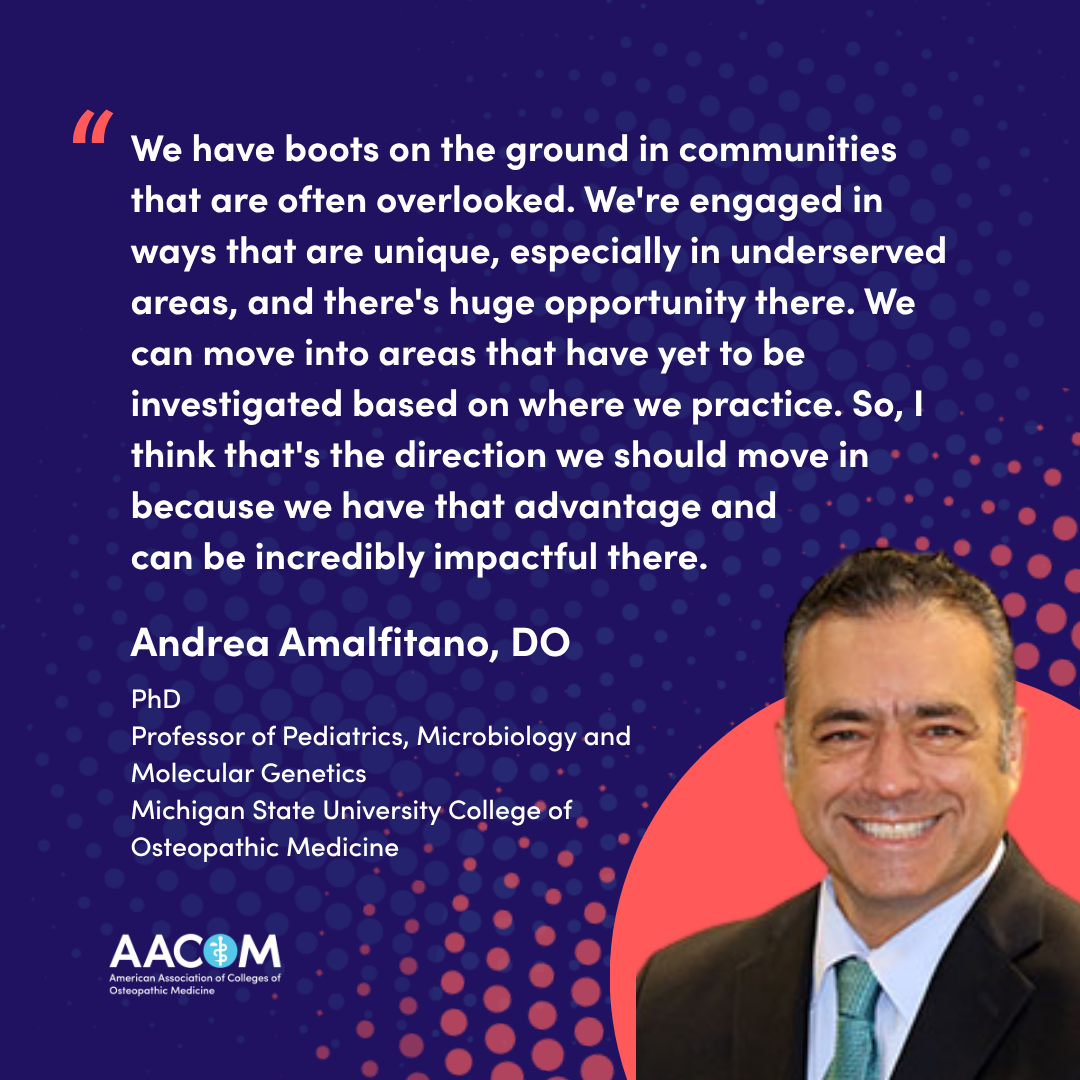
“The fact is, we have boots on the ground in communities that are often overlooked. We're engaged in ways that are unique, especially in underserved areas, and there's huge opportunity there,” he said, “We can move into areas that have yet to be investigated based on where we practice. So, I think that's the direction we should move in because we have that advantage and can be incredibly impactful there,” he shared.
Through curiosity, compassion and a steadfast commitment to translating science into healing, Dr. Amalfitano is delivering hope for his patients and inspiring a new generation of physician scientists to ask bold questions and seek innovation.
 Dr. Andrea Amalfitano earned a Bachelor of Science in microbiology in 1984 and a PhD in microbiology in 1989, both from Michigan State University. He earned his Doctor of Osteopathic Medicine, or DO, medical degree in 1990 from MSU College of Osteopathic Medicine’s DO-PhD dual-degree program. Prior to joining MSU in 2005, he served as an associate professor at Duke University in the Department of Pediatrics and the Department of Pathology, Molecular Genetics and Microbiology. Amalfitano is a board-certified clinical geneticist and a trained classical research scientist. His research focuses on determining the feasibility of cutting-edge therapeutics, including gene transfer, to treat both acquired and genetic diseases and then translating that knowledge into the clinical realm. His scholarly efforts in both clinical medicine and applied genetics have led to the development of innovative treatments for infants, children and adults affected by a variety of diseases, including lethal muscular dystrophies, cancer, autoimmune disorders and autism.
Spread the word!
Dr. Andrea Amalfitano is advancing breakthrough gene therapies that enable him to impact health for patients with rare diseases around the globe. In a new feature story, explore his career translating biomedical research into patient care and how he’s training a new generation of physician scientists along the way.
At the heart of Dr. Amalfitano’s research in immunotherapy is ensuring it connects back to his patients. See how his work is creating hope for his patients and building a new cohort of DO physician scientists.
At the intersection of breakthrough innovation, medical practice and osteopathic philosophy, you’ll find Dr. Andrea Amalfitano’s gene therapy research. In a new feature story explore how his holistic and patient-focused work is promoting health and hope for patients with rare and genetic diseases.
“We can move into areas that have yet to be investigated based on where we practice. So, I think that's the direction we should move in because we have that advantage and can be incredibly impactful there,” said Dr. Andrea Amalfitano, DO, PhD. Learn more about Dr. Amalfitano's pathway to research and how he’s mentoring the next generation of physician researchers to tackle today’s health challenges.