

Introduction to Artificial Intelligence
Module 1.
Purpose and Topics
Purpose
To ground faculty in the foundational concepts of artificial intelligence (AI) and its relevance in health professions education and practice.
Topics/Learning Objectives
Upon completion of this module, individuals will be able to:
- Define Artificial Intelligence
- Describe subsets of AI (e.g., machine learning, generative AI)
- Identify ways AI is being used across medical education, clinical environments and research
- Explain the importance of collaboration in AI-supported projects
Topic 1
What is Artificial Intelligence?
What is Artificial Intelligence?
Artificial intelligence (AI) refers to technologies endowed with the intellectual processes characteristic of humans, such as reasoning, discovering meaning, generalizing and learning from experience.
AI systems can recognize patterns, interpret language, adapt to new information and generate recommendations. Some operate with a degree of autonomy, as seen in technologies such as self-driving vehicles and virtual assistants. In healthcare, AI is increasingly applied across a wide range of functions—including image analysis, clinical decision support, workflow optimization, therapeutic planning, research and patient communication. In addition to AI, numerous adjacent technologies contribute to the evolving digital health landscape.
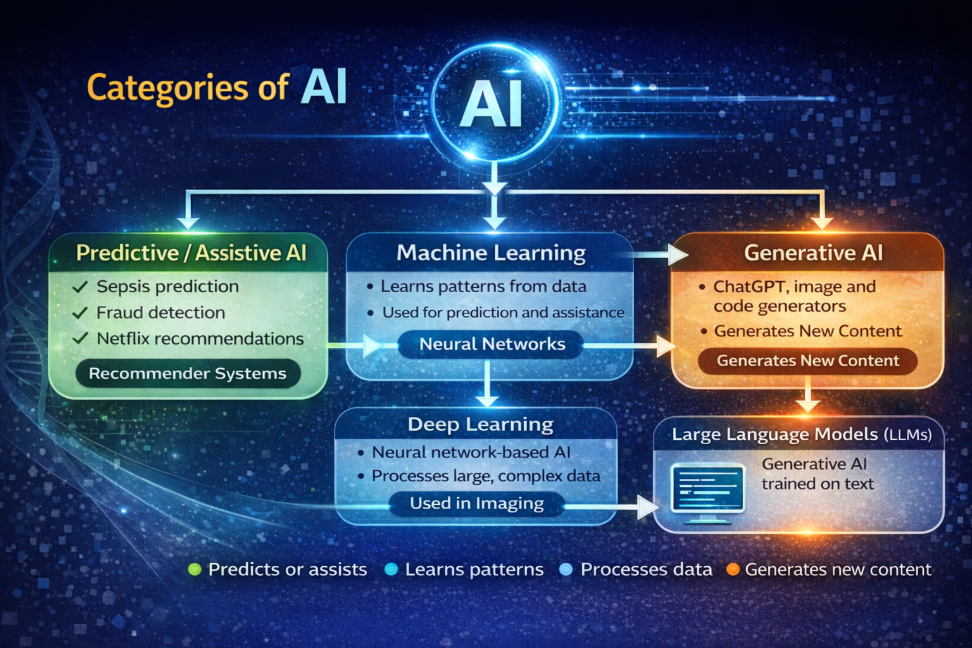
Overview
Artificial intelligence (AI) is a broad field that includes many different types of systems designed to perform tasks that typically require human intelligence. Within this field, several approaches have emerged that are particularly relevant to healthcare, education and research.
This module focuses on generative artificial intelligence and large language models (LLMs)—the technologies behind tools such as ChatGPT and similar AI assistants. These systems can generate text, summarize information, draft documents and assist with problem-solving.
Understanding how these models work—and their limitations—is essential for responsible and effective use in health professions education.
The AI Landscape
Artificial intelligence includes several related approaches. While these terms are often used interchangeably in popular discussions, they represent distinct concepts.
Artificial Intelligence
Artificial intelligence refers broadly to computer systems designed to perform tasks that typically require human intelligence, such as recognizing patterns, making predictions or generating language.
Examples in healthcare include clinical decision support tools, imaging analysis systems and predictive models used to estimate patient risk.
Machine Learning (ML)
Machine learning is a subset of AI in which algorithms learn patterns from data rather than relying solely on explicit programming.
Instead of being told exactly how to perform a task, machine learning models analyze large datasets to identify patterns and relationships that allow them to make predictions or recommendations.
Examples include:
- Predicting hospital readmission risk
- Fraud detection in healthcare billing
- Recommendation systems such as Netflix or Amazon algorithms
Deep Learning
Deep learning is a specialized type of machine learning that uses neural networks—computational models inspired by the structure of the human brain.
These models are particularly effective for complex tasks involving large datasets.
Common applications include:
- Medical image interpretation
- Speech recognition
- Natural language processing
Many modern AI systems used in healthcare rely on deep learning methods.
Generative AI (GenAI)
Generative AI represents a more recent development within deep learning.
Unlike predictive models that estimate outcomes or classify information, generative AI systems create new content based on patterns learned during training.
Examples of generated content include:
- Text
- Images
- Audio
- Code
- Video
Generative AI models analyze large amounts of data and learn patterns that allow them to produce new outputs that resemble the data they were trained on.
Large Language Models (LLM)
Large language models are a type of generative AI designed specifically to work with human language.
LLMs are trained on enormous collections of text—including books, articles, websites and other documents—to learn patterns in language.
Rather than retrieving information from a database, these models predict the next word in a sequence, generating responses based on statistical relationships learned during training.
This capability allows LLMs to perform tasks such as:
- Answering questions
- Summarizing information
- Drafting emails or reports
- Generating explanations
- Supporting brainstorming and idea development
Examples include tools such as ChatGPT and other AI writing assistants.
Understanding What LLMs Actually Do
One of the most important concepts for educators to understand is that LLMs do not “know” information in the way humans do.
Instead, they generate responses by predicting the most likely word sequence based on patterns learned during training.
As a result:
- LLMs may produce responses that sound convincing but contain inaccuracies
- They may generate fabricated citations or references
- Their outputs depend heavily on the prompt provided by the user
For this reason, AI-generated outputs should always be reviewed critically and verified, particularly in clinical or educational contexts.
Predictive AI vs. Generative AI
Not all AI systems generate content. Many AI tools used in healthcare are predictive or assistive rather than generative.
Examples of predictive or assistive AI include:
- Sepsis prediction models
- Risk scoring systems
- Clinical decision support alerts
- Recommendation algorithms
These systems analyze data to predict outcomes or suggest actions, whereas generative AI creates new content.
Understanding this distinction helps clarify where generative AI tools can and cannot be used effectively.
Implications for Medical Education
Generative AI tools offer several potential applications for educators.
Faculty may use these systems to:
- Draft or revise educational materials
- Generate practice questions
- Create clinical case scenarios
- Summarize research articles
- Support brainstorming during curriculum development
At the same time, these tools should be used with awareness of their limitations. Educators must carefully evaluate AI outputs and ensure that the content remains accurate, evidence-based and appropriate for learners.
Key Takeaways
- Artificial intelligence is a broad field that includes multiple approaches and technologies.
- Machine learning systems learn patterns from data to make predictions or recommendations.
- Deep learning uses neural networks to analyze complex datasets.
- Generative AI creates new content such as text, images or code.
- Large language models are generative AI systems designed to work with human language.
- AI outputs should always be evaluated critically before being used in educational or clinical contexts.
Generative AI
Much of the public conversation about AI centers around generative AI, a subset of AI that can produce new content, such as text, images or even computer code. Tools like OpenAI's ChatGPT, Google’s Gemini, Microsoft’s Copilot and others are built on machine learning and deep learning models trained on large amounts of data.
Understanding generative AI begins with understanding how these models learn and generate responses: why they are powerful, and where their limitations lie. We’ll explore both the capabilities and the constraints of these systems, so you can work with them responsibly, creatively and critically.
Machine Learning
Machine Learning is revolutionizing healthcare by enabling computers to analyze vast amounts of medical data and identify patterns that humans might miss. Understanding ML is crucial, as it powers diagnostic tools such as medical imaging analysis, drug-discovery algorithms and predictive models for patient outcomes. ML applications already assist physicians in detecting diseases earlier, personalizing treatment plans and reducing diagnostic errors across specialties from radiology to pathology. As future healthcare professionals, medical students who grasp ML concepts will be better equipped to leverage these powerful tools in clinical practice and contribute to evidence-based medicine.
Topic 3
Identify Ways AI is Being Used Across Medical Education, Healthcare Environments and Research
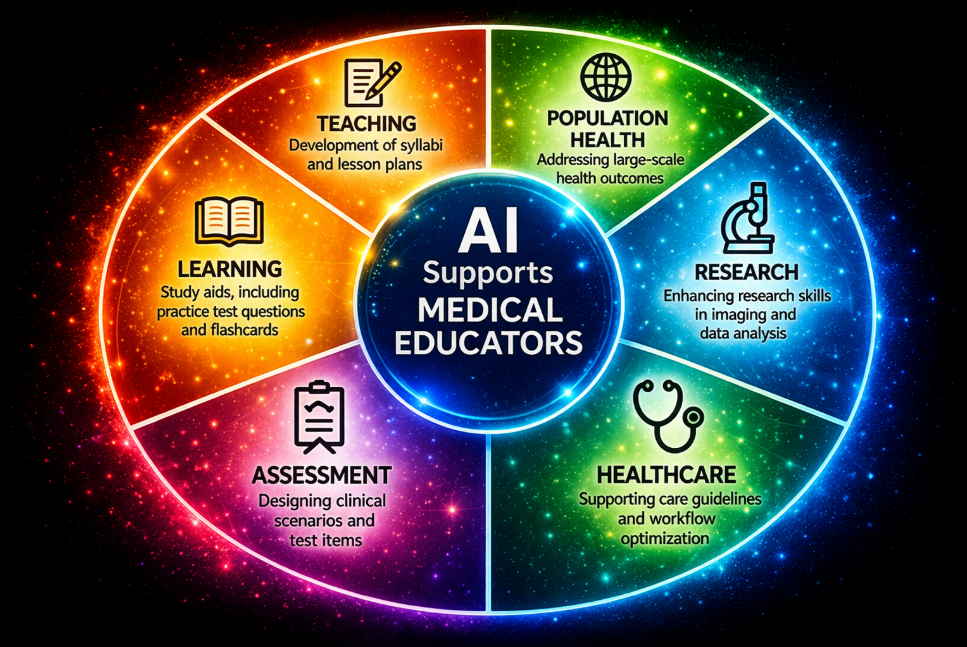
AI in Action: Six Key Domains of Medical Education and Healthcare Environments
As AI becomes increasingly embedded in health professions education and clinical environments, it's helpful to consider how it is being used to support core domains that span medical training. Here are six areas where AI tools and applications are actively transforming the way we teach, learn, assess, research, care for patients and address public health.
Teaching
AI can enhance instructional design and classroom engagement by:
- Assisting faculty in developing syllabi, lesson plans and structured modules.
- Supporting the creation of interactive, adaptive learning activities for class sessions.
Learning
AI enables students to personalize and accelerate their learning by generating:
- Study aids like flashcards, lecture summaries and concept explanations tailored to the learner’s needs
- Practice quiz questions
- Case-based learning and role play
Assessment
AI can help design high-quality assessments aligned with real-world competencies:
- Generating clinical scenarios and high-quality test items
- Supporting rubric development and providing formative feedback through automated scoring or peer comparison
Research
AI is a valuable partner in developing research acumen, especially in:
- Imaging analysis, data visualization and therapeutic modeling
- Supporting needs assessments for specific populations
- Streamlining literature reviews, organizing references and optimizing study design
Healthcare Practice
AI tools are already being used in:
- Clinical decision support systems, image interpretation and EHR integration
- Workflow optimization and diagnostic assistance
- Robotics and surgical planning tools that enhance precision and safety
Population Health
AI plays an increasing role in identifying and addressing health disparities:
- Supporting the application of health equity frameworks across diverse populations
- Analyzing health trends using surveillance systems, registries and geographic tools
- Informing and evaluating evidence-based public health interventions
Topic 4
The Importance of Collaboration in AI-Supported Projects
Using AI Collaboratively: Building Skills and Learning Together
Artificial intelligence is changing how knowledge is generated, interpreted and applied in medicine. Because these technologies intersect with clinical care, education, data science and technology development, their effective use depends on collaboration. Progress in AI rarely emerges from a single perspective; it develops through the combined insight of individuals with different expertise who work together to design, test and refine new approaches.
Building AI Skills Through Collaborative Peer Learning
Developing skills with AI is often accelerated through shared exploration. Faculty who discuss their experiences with colleagues, test tools together or participate in small AI-focused initiatives frequently identify practical applications more quickly than those working independently.
For example, one educator may develop a prompt that generates board-style questions aligned with learning objectives, while another may use AI to produce structured patient cases for small-group teaching. Others may experiment with prompting AI to explain complex topics—such as cardiac physiology or pharmacologic mechanisms—at different levels appropriate for novice and advanced learners. Sharing these strategies helps educators refine their use of AI while recognizing limitations in the outputs.
Collaborative experimentation also helps identify potential concerns. Faculty discussions often surface issues such as fabricated citations, incomplete reasoning in clinical explanations or risks related to sensitive information. These conversations support more thoughtful and responsible integration of AI into educational practice.
AI as a Cognitive Partner in Professional Work
When used deliberately, AI can support idea development, organization of complex information and exploration of alternative approaches. Rather than serving solely as a tool for generating content, it can function as a resource for structured reflection during problem-solving.
A faculty member preparing a lecture might ask AI to suggest multiple ways to frame a difficult concept or generate likely questions students could raise. A clinician planning a quality improvement initiative might request potential variables, alternative study designs or additional factors that should be considered when evaluating outcomes. These interactions can broaden analysis and encourage more deliberate reasoning before final decisions are made.
Interdisciplinary Collaboration in AI Development
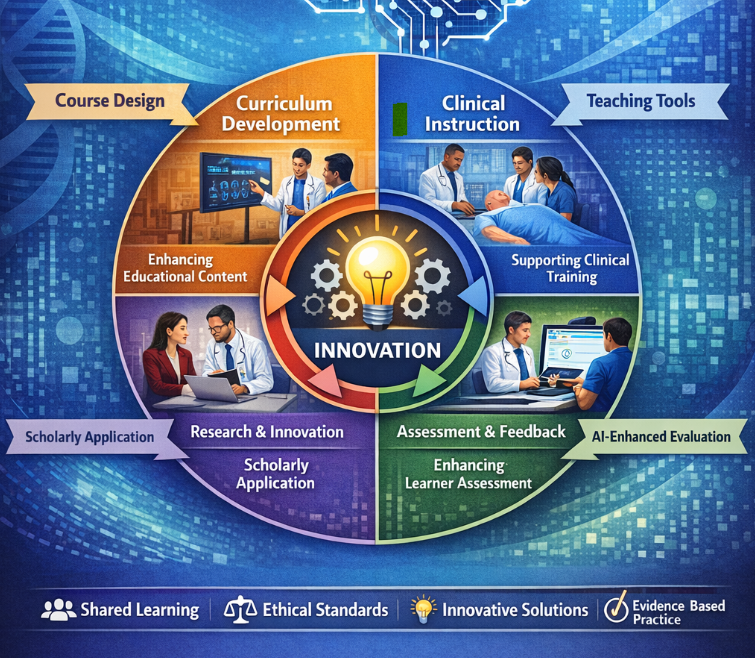
Successful AI systems in healthcare emerge from interdisciplinary teams. Health professionals provide clinical context and define real-world needs. Data scientists design and train models using appropriate datasets. Engineers develop the infrastructure required to build, test and maintain the technology. Industry partners contribute expertise in product development, regulatory navigation and large-scale implementation.
Consider the development of an AI tool designed to support patient communication. Clinicians identify common challenges in patient understanding, data scientists develop language models capable of generating clear explanations, engineers build the interface and system architecture and industry teams support testing, deployment and regulatory compliance.
Similarly, tools designed to support medical education—such as AI-assisted feedback on clinical documentation or adaptive tutoring systems—require collaboration between educators, technical specialists and healthcare professionals to ensure accuracy, usability and educational relevance.
Advancing AI Through Team-Based Innovation
Effective engagement with AI requires iterative testing, critical evaluation of outputs, and continuous refinement of approaches. Faculty who collaborate with colleagues and technical experts are better positioned to identify meaningful applications while recognizing the technology’s limitations. Many of the most significant advances in AI-supported healthcare will emerge from teams that integrate clinical expertise with technical innovation.
Supplementary Materials & Resources
Supplementary Materials
- PowerPoint
- Flashcards
- Google NotebookLM or GEM
Resources
Articles
- Gordon, M., Daniel, M., Ajiboye, A., Uraiby, H., Xu, N. Y., Bartlett, R., & Thammasitboon, S. (2024). A scoping review of artificial intelligence in medical education: BEME Guide No. 84. Medical Teacher, 46(4), 446-470
- Narayanan, S., Ramakrishnan, R., Durairaj, E., & Das, A. (2023). Artificial intelligence revolutionizing the field of medical education. Cureus, 15(11).
- Saroha, S. (2025). Artificial intelligence in medical education: promise, pitfalls, and practical pathways. Advances in medical education and practice, 1039-1046.
- Wartman, S. A., & Combs, C. D. (2018). Medical education must move from the information age to the age of artificial intelligence. Academic Medicine, 93(8), 1107-1109.
Videos
- AI Skill Building for Medical Educators
- Artificial Intelligence In and For Medical Education
- Foundations of Skill-Building with Artificial Intelligence
Websites
Note: The text and graphics in these modules were co-developed with the assistance of generative AI tools such as OpenAI’s ChatGPT, Google’s Gemini and NotebookLM and Microsoft’s CoPilot, drawing on the indicated reference materials. The materials were then edited for relevance and accuracy.
