

Responsible Use of AI in Medical Education
Module 3.
Purpose and Topics
Purpose
This module prepares medical educators to use AI responsibly, ethically and effectively across academic, clinical and scholarly contexts. As AI becomes increasingly integrated into health professions education, faculty require a nuanced understanding of their professional responsibilities when using these tools.
The goal is not simply to learn how to use AI, but to develop the judgment necessary to integrate it safely into educational and student clinical decision learning environments.
This module outlines three core domains of responsible AI use. More detailed guidance is available through institutional policies and professional organizations, some of which are included in the supplementary materials.
Topics/Learning Objectives
Upon completion of this module, individuals will be able to:
Define responsible, ethical and professional AI use in the context of medical education and emerging institutional standards.
- Describe the core domains of responsible AI use, including ethics and academic integrity, data stewardship and critical thinking.
- Model responsible AI practices for learners and contribute to a culture of transparency and professionalism.
- Apply critical thinking when reviewing AI-generated output and when using AI to develop instructional materials, assessments, case scenarios or scholarly work.
What Is Responsible AI Use in Medical Education?
Responsible AI use refers to the thoughtful, ethical and professionally grounded integration of AI tools into teaching, assessment, scholarship and academic decision-making.
It involves using AI in ways that:
Align with institutional policies and professional standards
Maintain academic integrity and honesty
Respect ethical, professional and regulatory obligations
Promote responsible stewardship of data
Support educational goals without replacing human expertise
Responsible use emphasizes judgment rather than technical expertise. Faculty do not need to be AI specialists, but they must make sound, professional decisions about when, how and why AI is used.
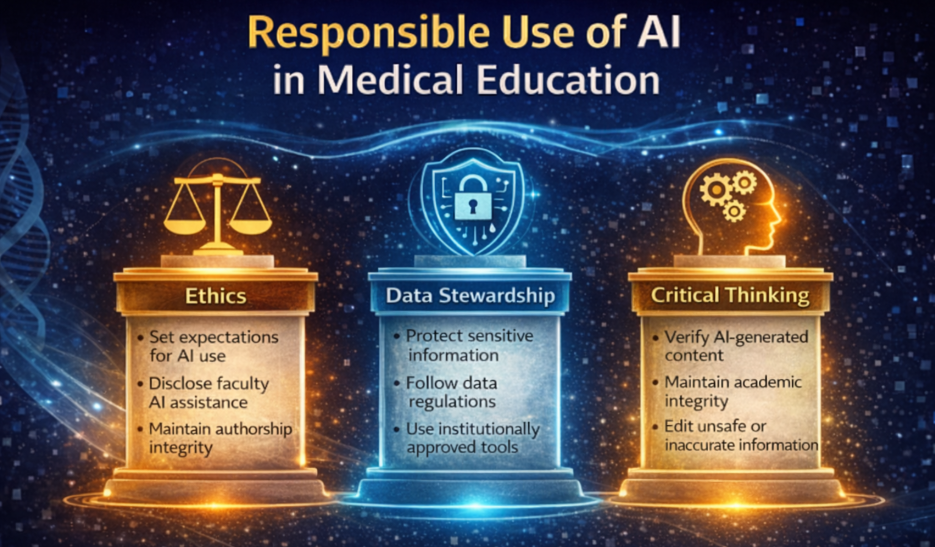
Part 1
Ethical & Transparent Use
AI use must reflect core academic values: honesty, professionalism, fairness, accountability and respect for patient and learner privacy.
Best Practices
1. Stay Aligned with Institutional Guidelines for AI Use
AI use should reflect core academic values, including honesty, professionalism, fairness, accountability and respect for patient and learner privacy.
Many medical schools, clinics and departments provide AI guidance, which may include:
Approved tools across public, enterprise and research environments
Data governance and security protocols
Guidance for teaching, learning and scholarship
Expectations for citation and disclosure of AI use
When uncertainty exists, faculty should consult IT, compliance or data governance offices.
2. Establish and Role Model Academic AI Integrity
Faculty should maintain transparency about how AI contributes to their work. This includes:
Acknowledging when AI has generated or significantly shaped content
Explaining how AI tools were used in workflows
Identifying where faculty judgment informed the final output
Teaching learners how to appropriately disclose their own AI use
Why this matters: Transparency builds trust, reinforces professionalism and models responsible behavior for learners.
Examples of inappropriate use include:
Assigning AI tools that are not equitably accessible
Allowing AI to generate fabricated references
Presenting AI-generated content as original expert work
Using AI for scholarly work without meaningful review or editing
Failing to disclose AI assistance when it influences academic output
3. Establish Written Expectations and Guidelines for Learners
Aside from institutional policies that align with faculty policies, faculty should clarify to learners:
What types of AI use are permitted in an assignment or research project
What types are prohibited (e.g., answering exam questions)
How students must disclose their AI use
How AI misuse will be handled
Clear expectations reduce misunderstandings and academic misconduct. Responsible use of AI can be demonstrated through simple practices within teaching environments.
Examples include:
Explaining to learners when AI tools were used to help generate teaching materials
Setting course-level expectations for acceptable AI use
Reviewing AI-assisted student work for originality and integrity concerns
Encouraging learners to critically evaluate AI-generated content
In Conclusion
AI policies vary widely across institutions, and they evolve quickly. Best practices include:
Staying updated on institutional AI guidance and approved tools
Consulting IT/compliance before using AI with institutional, learner or patient-related information
Disclosing when AI meaningfully contributes to instructional or scholarly content
Setting clear expectations for learner use of AI in courses or programs
Part 2.
Data Stewardship and Security
Faculty must also consider how AI tools handle data. Many publicly available AI tools process user inputs outside institutional systems, meaning information entered into these tools may not remain private.
For this reason, it is important to protect sensitive educational, research and clinical data.
Best Practice
1. Follow Institutional Policies Regarding Data Stewardship
Faculty should ensure their use of AI aligns with institutional data security guidelines. This requires not only familiarity with relevant policies, but also an understanding of the rationale behind them. Key responsibilities include:
Handling sensitive data appropriately, in compliance with regulations such as FERPA, HIPAA and applicable research data protection standards.
Understanding institutional data protections, including those embedded within enterprise-level AI systems.
Distinguishing between personally identifiable information and publicly accessible data.
Clearly disclosing how AI-generated outputs (e.g., meeting notes) will be reviewed, stored and used.
Adhering to Institutional Review Board requirements when applicable.
Following guidance from institutional policies and professional organizations regarding AI use in education and healthcare.
More information can be accessed at the AI Governance section.
What Is Personally Identifiable Information?
Personally Identifiable Information (PII) refers to any information that can directly or indirectly identify an individual.
In medical education and healthcare environments, PII often overlaps with Protected Health Information.
Examples include:
Names
Dates of birth
Medical record numbers
Contact information
Student ID numbers
Clinical case details that could identify a patient
Uploading identifiable information into non-approved AI tools may violate institutional policies or legal protections such as FERPA, HIPAA or research data regulations.
Faculty should assume that data entered into public AI tools may not remain private.
Faculty Practice Examples
Examples of responsible data practices include:
Avoiding the upload of real patient or student data into public AI tools
Choosing enterprise AI tools when working with institutional or research data
Removing identifying information from clinical cases before using AI to generate educational materials
Distinguish between public AI tools and institutionally approved or enterprise systems
Apply data minimization and de-identification principles
Follow institutional and regulatory data protection requirements
Part 3.
Applying Critical Thinking and Discernment in Evaluating AI Output
AI can be a valuable tool in supporting the development of educational and research materials; however, its use requires careful discernment and the ability to critically evaluate AI-generated outputs. This topic will be addressed more comprehensively in Module 6. In general, medical educators learn to critically review AI-generated output, such as…
Whether the information is accurate
Whether it reflects current clinical and educational standards
Whether it introduces bias or misinformation
Whether it aligns with program goals and the intended learner level
AI-generated material should always be reviewed thoroughly before use in educational settings. Faculty are responsible for ensuring that content is accurate, safe and appropriate for learners. Because generative AI systems produce responses based on patterns in language rather than verified knowledge, outputs may at times be incomplete, unrealistic or potentially unsafe.
Accordingly, faculty should:
Verify the accuracy and appropriateness of AI-generated content
Edit AI-generated case materials to remove unrealistic or unsafe clinical elements
Ensure that teaching materials align with current medical standards and guidelines
Review any AI-generated references or sources for accuracy and validity
AI can effectively support educational preparation, but it should not replace faculty judgment or professional expertise.
Smart Use Tips
The following strategies can help faculty use AI tools effectively and responsibly:
Verify AI-generated academic or clinical content before use
Design AI educational activities to support reasoning, not replace it
Stay alert to confident language that lacks evidence
Ask AI to provide sources and verify them independently
Consider whether AI-generated material is appropriate for the educational context
Responsible use of AI combines ethical practice, policy awareness and professional judgment.
Supplementary Materials & Resources
Supplementary Materials
PowerPoint
Flashcards
Google NotebookLM or GEM
Resources
Articles
Gin BC et al. Entrustment and EPAs for Artificial Intelligence in Health Professions Education. Academic Medicine. 2025.
Komasawa, N., & Yokohira, M. Generative artificial intelligence (AI) in medical education: a narrative review of the challenges and possibilities for future professionalism. Cureus, 17(6), e86316. 2025.
Masters K. Ethical use of artificial intelligence in health professions education: AMEE Guide No. 158. Medical Teacher. 2023.
Videos
Websites
Note: The text and graphics in these modules were co-developed with the assistance of generative AI tools such as OpenAI’s ChatGPT, Google’s Gemini and NotebookLM and Microsoft’s CoPilot, drawing on the indicated reference materials. The materials were then edited for relevance and accuracy.
