The Science of Touch: Bridging the Gap Between Experience and Evidence
Published April 20, 2026
Research Stories Research Stories Report Page
For more than 150 years, osteopathic manipulative medicine (OMM) has been a unique and distinguishing tool for the osteopathic profession to catalyze health. When Brian Degenhardt, DO, first witnessed the power of OMM as a medical student, he was captivated.
During a lesson on treating ear infections with OMM, Dr. Degenhardt recalls when he earnestly asked for the evidence behind it; his professor asserted that their clinical experience was proof enough.
“I had questions about the science behind OMM through medical school and none of my teachers really had good answers for me. It was because the research and the evidence really didn't exist to properly evaluate the complexity of the neuromusculoskeletal system,” said Dr. Degenhardt.
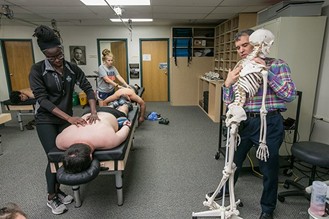
Dr. Degenhardt demonstrating OMM techniques with students
This experience ignited a drive within him to question: How does OMM work, and where is the evidence behind this practice? As the endowed chair for research in osteopathic diagnostic and therapeutic palpation at A.T. Still University’s Kirksville College of Osteopathic Medicine (ATSU-KCOM), Dr. Degenhardt is working to bring clarity to the underlying mechanisms behind OMM.
"To objectify the most fundamental aspects of how we use our hands on a patient is very important. What do our hands do, what are the basic properties? Our hands apply forces in different directions for different durations. They have to be able to localize and influence physical properties in the body. In order for any science in this field to be valid, we have to have valid instruments, that's our hands, and we've got to be able to train them through evidence-based methods,” explained Dr. Degenhardt.
Since his time in medical school, the research landscape has changed to offer huge opportunities to study OMM, Dr. Degenhardt shared. "Over the last 20 years, science and technology have significantly evolved and become so robust that meaningful research in the complexities of the neuromusculoskeletal system has developed across all professional specialties and biomedical sciences. And I really think that the osteopathic profession needs to have an active role in these discoveries,” he added.
Through his desire to bridge the gap between experience and evidence, Dr. Degenhardt has propelled osteopathic research forward, seeking to build the evidentiary foundation for OMM and inspire osteopathic physicians and students to pursue medicine through inquiry and innovation.
Advancing the Evidence
As a resident doctor, Dr. Degenhardt continued studying ear inflammation and infection in children, beginning to fill the void in literature that sparked his passion for research and uncovering insights into what creates the benefits when OMM is applied.
“OMM was supposed to work for this condition, but I had no specific training to know how to approach this condition. So, I thought I might as well just examine things, see what I find, treat what I find and see what happens. And that's what drove me back [to study this] during residency, early in my career. I did two studies looking at otitis media in children and [after applying OMM] the issues resolved; it had a very clear pattern," reflected Dr. Degenhardt on his initial research.
These early studies not only deepened clinical insight but helped Dr. Degenhardt realize how much more there was to learn. In 2010, Dr. Degenhardt was part of a landmark study, funded by a group of foundations led by the Osteopathic Heritage Foundation (OHF), that examined the efficacy of OMM to treat hospitalized older patients with pneumonia, known as the Multicenter Osteopathic Pneumonia Study in the Elderly (MOPSE). The results were promising. Though the study was underpowered for definitive outcomes, patients who received OMM in addition to conventional treatment went home faster, had less serious adverse events from the pneumonia and saw reduced costs for care.
“I was responsible for overseeing the intervention arm of the MOPSE study. We engaged more than 80 OMT providers and more than 400 patients in this study,” Dr. Degenhardt shared.
Dr. Degenhardt recognized that for OMM to gain acceptance in broader medical circles, it needed rigorous, reproducible evidence, so he shifted his attention to measurement and standardization of OMM practices. Under his leadership, new tools and protocols were developed to measure the exact forces applied during manipulative treatments and assess physician precision in detecting skeletal asymmetry—key indicators for identifying dysfunction and promoting health.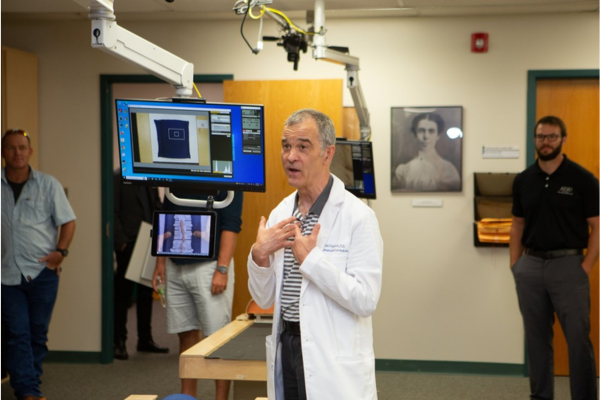
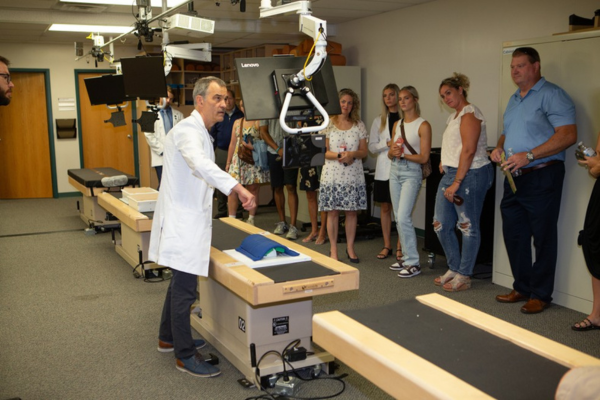
Dr. Degenhardt in the lab giving an OMM demonstration to visitors
To create a dedicated resource to collect this work, Dr. Degenhardt helped establish DO-Touch.NET, a global practice-based research network that collects real-world outcomes about patients’ experiences with OMM. The data showed that 83 percent of patients treated with OMM reported symptom improvement immediately after treatment and 75 percent after one week. By developing frameworks that support consistent measurement of the efficacy and outcomes of OMM, Dr. Degenhardt’s research is supporting the foundation of evidence and outcomes needed for today’s science-based approach to care.
None of these advances in care would be possible without the OHF, Dr. Degenhardt shared. By partnering with ATSU-KCOM in establishing an endowed professorship for Dr. Degenhardt and creating others across the country, OHF enabled the creation of advanced research labs and ability to train students and practicing physicians.
“I have been so thankful for this opportunity. My career would have been so different had I not had that endowment. What I've been able to accomplish and the careers of others that I’ve been able to support, I think is quite remarkable and important,” Dr. Degenhardt reflected.
Holistic Approaches to Research and Patient Care
OHF’s endowment allows Dr. Degenhardt to pursue what matters most to him: improving care and health.
The impact of Dr. Degenhardt’s work can best be seen at the bedside. His work has empowered physicians to offer evidence-based treatments with fewer side effects than conventional pain management, such as opioids. According to Dr. Degenhardt, there continues to be an extensive amount of opportunity for more research.
“There are so many aspects of medicine that we know need to be advanced, whether that is access of rural or underserved people into current healthcare including OMM, or better understanding what factors those populations have that have never been studied, and as a result, aren't being adequately addressed,” shared Dr. Degenhardt.
He views OMM as a truly personalized medicine where the physician’s skill, combined with an understanding of the patient’s unique context, leads to more effective care. Uniquely, it also provides opportunity for deeper connection and compassion between physicians and patients, one that Dr. Degenhardt believes is just vital as scientific validation.
“I believe osteopathic medicine provides the most comprehensive healthcare based on its principles and practices. I don't know of another profession that has more comprehensively and systematically integrated those understandings throughout their training program,” Dr. Degenhardt said.
Fostering Curiosity and Compassion in Care
The osteopathic profession’s holistic philosophy can—and should—shape the future of medicine, Dr. Degenhardt believes. And early engagement in research for osteopathic medical students helps shape physicians who are active contributors in the scientific process and bring their holistic focus to all stages. He hopes that every physician acknowledges their role as a researcher, blending clinical experience with ongoing discovery, to provide gold-standard care.
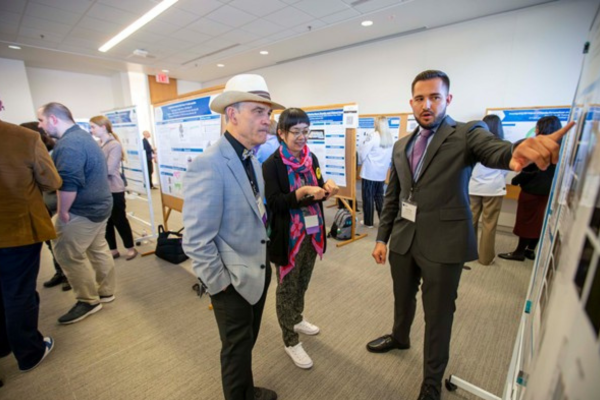
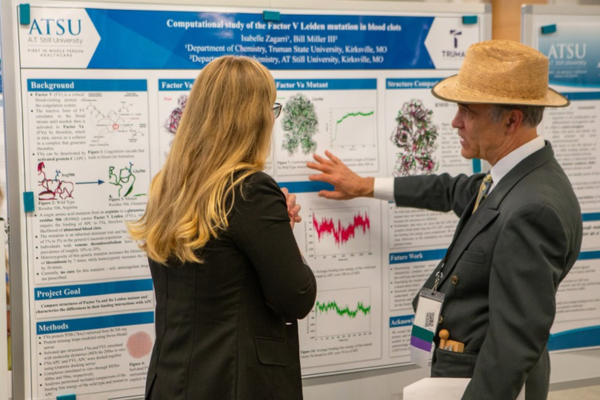
Dr. Degenhardt at the annual Interdisciplinary Biomedical Research Symposium held on ATSU-COM’s Kirksville campus
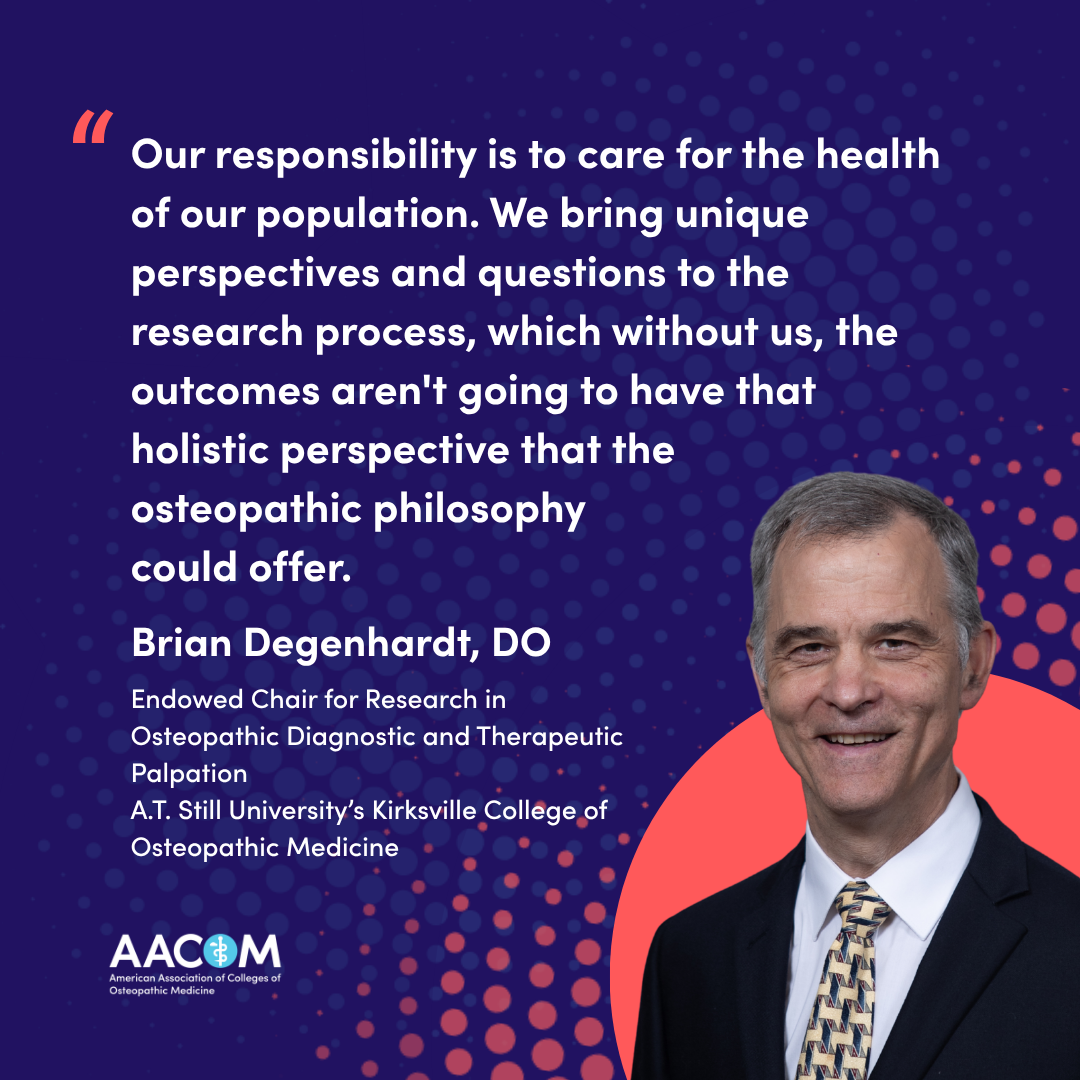
“Our responsibility is to care for the health of our population,” Dr. Degenhardt explained. “We bring unique perspectives and questions to the research process, which without us, the outcomes aren't going to have that holistic perspective that the osteopathic philosophy could offer.”
Dr. Degenhardt has shaped osteopathic curricula to ensure students are trained to improve care for future generations. He argues that the responsibility of a physician extends beyond individual patient care—also to advance the field itself. His goal is to see more clinicians engaged in research, make OMM a standard part of patient care and ensure that underserved populations are not left behind.
“We need to make sure that our students are getting the same level of exposure and training within osteopathic training programs. We need niches for those excelling to “pay forward” those skillsets back to that next generation of osteopathic students," said Dr. Degenhardt.
Looking ahead, Dr. Degenhardt envisions a future where osteopathic research is integral to all aspects of healthcare. He is committed to breaking down barriers, expanding collaborative networks and building relationships with major research institutions and agencies.
“We need to nurture curiosity in our students, so the next generation will push the boundaries of what is possible. I see in this next generation an exponential increase in clinician researchers that are actively engaged in patient care, certainly within the field of manipulative medicine but not just at osteopathic institutions,” said Dr. Degenhardt on his excitement for the future of osteopathically-aligned research.
 Dr. Degenhardt has proven his commitment to holistic care and constant inquiry in pursuit of better health outcomes. As he makes advancements in osteopathic research, he also inspires new generations of future DOs to enact change through innovation.
Brian F. Degenhardt, DO, serves as assistant vice chancellor for osteopathic research at the A.T. Still University-Kirksville College of Osteopathic Medicine and is a distinguished figure in osteopathic medicine and osteopathic manipulative medicine. His pivotal roles include director of the Center for Research in Osteopathic Manipulative Medicine and director of DO-Touch.NET, both housed within A.T. Still Research Institute. Additionally, Dr. Degenhardt holds the prestigious Osteopathic Heritage Foundation Endowed Chair for Research in Osteopathic Diagnostic and Therapeutic Palpation.
Dr. Degenhardt has proven his commitment to holistic care and constant inquiry in pursuit of better health outcomes. As he makes advancements in osteopathic research, he also inspires new generations of future DOs to enact change through innovation.
Brian F. Degenhardt, DO, serves as assistant vice chancellor for osteopathic research at the A.T. Still University-Kirksville College of Osteopathic Medicine and is a distinguished figure in osteopathic medicine and osteopathic manipulative medicine. His pivotal roles include director of the Center for Research in Osteopathic Manipulative Medicine and director of DO-Touch.NET, both housed within A.T. Still Research Institute. Additionally, Dr. Degenhardt holds the prestigious Osteopathic Heritage Foundation Endowed Chair for Research in Osteopathic Diagnostic and Therapeutic Palpation.
Spread the word!
A new feature story highlights Brian Degenhardt’s, DO, drive to advance OMM research. Learn how his work is strengthening the evidence behind the practice and helping DOs practice gold-standard care through touch.
How are DO’s shaping the future of hands-on healing? Hear Dr. Degenhardt reflect on the evolution of OMM research, the new era of innovation in manipulative medicine and the importance of inspiring future physicians to be curious.
“Our responsibility is to care for the health of our population. We bring unique perspectives and questions to the research process, which without us, the outcomes aren't going to have that holistic perspective that the osteopathic philosophy could offer,” says Brian Degenhardt, DO. Learn how Dr. Degenhardt is advancing the evidence behind osteopathic manipulative medicine while inspiring future physicians to engage meaningfully in research.
With a vision for expanding the evidence behind OMM, Brian Degenhardt, DO, is working to uncover the mechanisms behind the practice and foster curiosity in the next generation of OMM researchers. Learn more about his experiences advancing the evidence base and shaping better patient care.