Medicine Informed by Culture, Connection and Care
Published April 20, 2026
Research Stories Research Stories Report Page
Medicine is about people, community and trust for Negia Gamboa. It's a practice that allows her to connect to her culture and reach communities that have been overlooked by traditional medicine.
Negia was raised in a Filipino household in San Diego, California, and immersed in a community-oriented culture where care for one another was daily practice. Large community gatherings and shared meals cultivated a deep sense of care and connection that shaped her worldview early on. These values of culture, connection and care became the foundation for the type of physician she hopes to become—one who sees medicine as an opportunity to care for all aspects of her patient’s health and well-being.
"My upbringing made me want to advocate for others. Healthcare needs various approaches to care for people and their individual needs. Osteopathic medicine, with its tenets of body, mind and spirit, takes those different aspects of health into consideration, like socioeconomic factors, mental health, culture. And that's honestly what I feel like I get to do now,” shared Negia on her approach to care.
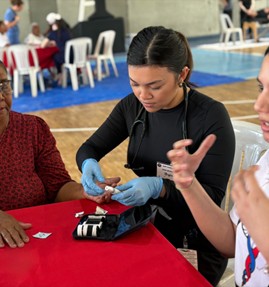
Negia performing a glucose monitoring test on a patient during the Dominican Republic medical outreach trip where students visited various local villages and offered care at makeshift clinics. This experience reinforced the need for culturally competent care and patient partnership in care. She was awarded RVU-MCOM’s Global Scholar of the Year for her commitment to advancing global health.
While living and training at Rocky Vista University Montana College of Osteopathic Medicine (RVU-MCOM), Negia had many opportunities to learn about the different cultures that were part of her local community, which has a large presence of American Indian communities.
When she came across an article from the American College of Obstetricians and Gynecologists (ACOG) highlighting alarming trends in maternal mortality for American Indian and Alaska Native women, Negia knew she needed to find solutions that could help individuals in her community live better, healthier lives. “I was shocked by the findings. This was something I had never heard about before, and that alone told me there was a problem,” she said.
Leading the Change
Under the mentorship of Joseph Bell, DO, an OB‑GYN faculty member at RVU-MCOM, Negia constructed a research project focused on understanding and addressing maternal morbidities among American Indian and Alaska Native women, beginning with a literature search. Together, the pair employed targeted search strategies using combinations of terms related to maternal cardiovascular health, pregnancy outcomes and Indigenous populations.
Unlike her peers, who sometimes had hundreds of peer-reviewed studies to inform their research project, Negia was troubled to find virtually no research to draw from.
“[Encountering this lack of information] was something that even more strongly drew me into this project and to provide a foundation for further research in this area,” she explained.
Research on advancing maternal health outcomes for American Indian and Alaska Native women, a community that has long been overlooked in medical literature. Health data for these groups faces many challenges leading information to either be excluded due to small population size or aggregated in a way that diminishes any ability to draw useful insights for the distinctive subgroups that can improve health.
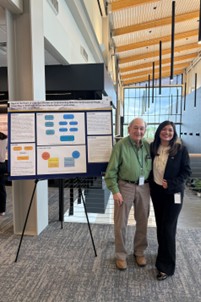
Dr. Bell and Negia presenting their literature review at MCOM Spring Research Day 2025
Ultimately, her literature review relied on just six peer‑reviewed articles relevant to American Indian and Alaska Native populations—an astonishingly small body of evidence for a population experiencing some of the highest pregnancy‑related mortality rates in the country.
The literature search process further reinforced for Negia how under researched her topic of study was within her medical school community, which was located in close proximity to different Tribal communities “That was one of the most unsettling parts,” she shared. “Not just that the outcomes were so severe, but that there was so little research to even begin addressing the gap in care.”
How does one address a problem defined by an absence of information? That scarcity of knowledge became the purpose for Negia. Without a sufficient evidence base, clinicians lack the guidance needed to improve outcomes, tailor care or even fully understand the drivers of risk. Negia recognized that before interventions could be developed, the field first needed a clearer insight into what is known—and where the gaps remain.
Following the Literature
Not to be stymied by the outcomes of their first phase, Negia and Dr. Bell looked at the information they had. One of the most prominent data sources they encountered was the Strong Heart Study—the largest study involving American Indian populations—but its focus was primarily on cardiovascular disease and diabetes, not pregnancy‑specific outcomes. As a result, Negia and her mentor had to carefully extrapolate relevant insights from the six studies while remaining mindful of the study’s limitations.
Through their analysis, Negia and Dr. Bell were consistently pointed beyond individual health behaviors to broader structural and social drivers of maternal morbidity and mortality. The key drivers that emerged repeatedly included:
- High rates of intimate partner violence | Some studies reported that up to 84 percent of American Indian and Alaska Native women experience violence in their lifetime, with rates increasing nearly 30 percent during pregnancy.
- Institutional and structural racism | Historical and ongoing inequities within healthcare systems contributed to mistrust, delayed care and poorer outcomes for pregnant American Indian and Alaska Native women.
- Lack of culturally competent care | Patients often received care that did not align with the values, lived experiences or community/cultural.
“What stood out was how much of this morbidity is preventable,” Negia explains. “But prevention requires awareness and evidence. That gap in research and data matters. If we’re not asking the right questions, we’re missing opportunities to protect patients,” she continued.
Beyond insights, Negia’s project sought to focus on creating clinical interventions and ensure that evidence translates into care that is collaborative, respectful and proactive.
As Negia looked to actionable tactics addressing the factors impeding maternal health for American Indian and Alaska Native women in her community she always had collaboration in mind, sharing, “care shouldn’t just happen to patients, it should happen with them.”
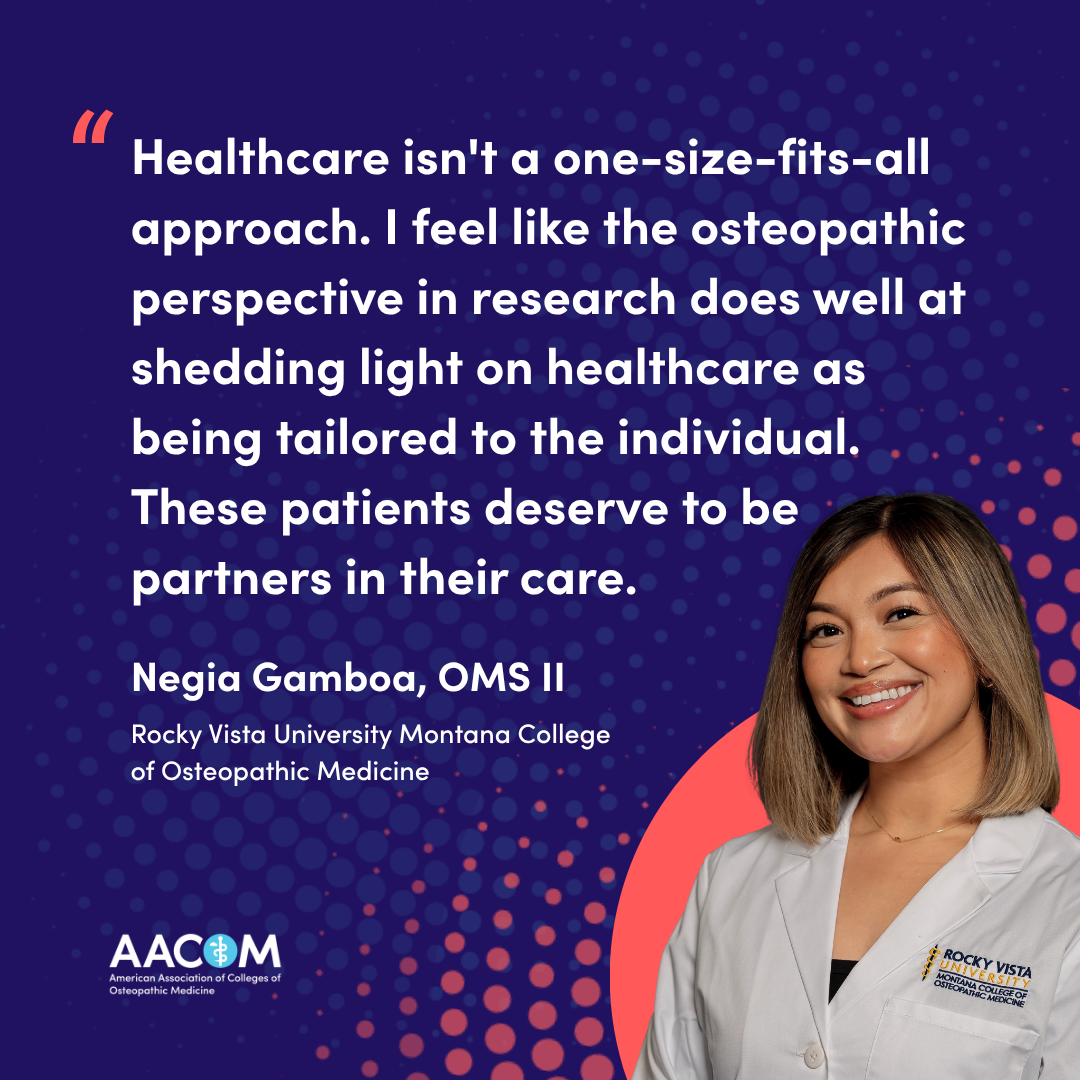
She translated these values and insights into recommendations for routine screening for intimate partner violence during pregnancy and shared decision‑making approaches that emphasize communication. “Healthcare isn't a one-size-fits-all approach. I feel like the osteopathic perspective in research does well at shedding light on healthcare as being tailored to the individual,” Negia shared.
Recognizing that these communities have faced historical trauma related to medical systems was an important consideration in understanding additional needs around culturally informed practices and non‑stigmatizing behaviors in patient care. “These patients deserve to be partners in their care,” Negia explained. “Especially given the history of exploitation and mistrust, clinicians need to listen first.”
To better inform and define these practice-based solutions, her next step is looking for ways to partner and engage with Tribal communities to better understand cultural practices around maternal health and to disseminate resources to help address some of the common health concerns (cardiovascular disease, intimate partner violence) she found in her research.
“Something that we're currently trying to overcome in this type of research is being able to speak with these communities. Even though they are local to us, understandably, there are certain limitations in gaining access to communicating with them and going out into their communities. So, that's something that Dr. Bell and I are still discussing, is how to actually build this relationship and provide resources,” Negia shared.
Advancing Evidence, Education and Care
Through this initial work, Negia was encouraged to see strong interest from faculty and peers during campus presentations. “We’ve made some progress not only in terms of carrying out the research, but actually in starting to have the culturally competent care that is much needed for these communities. I would want this to serve as a foundation and a call for more research to be done for these populations,” she reflected.
Beyond its academic contributions, the research experience profoundly shaped how Negia approaches medicine. Conducting the review sharpened her ability to critically evaluate evidence, recognize bias in data collection and understand how evidence gaps affect patient care.
Through this project, Negia recognized that a physician’s role often extends beyond the exam room to meaningfully impact health. To help shape outcomes for women in and beyond her community, especially those experiencing the health disparities she identified through her review, Negia served as ACOG’s student physician representative to help improve women’s healthcare at the policy level. She attended the ACOG Congressional Leadership Conference and met with Montana government officials to ensure all mothers receive financial coverage during pregnancy, which addressed one of the barriers uncovered in her research.
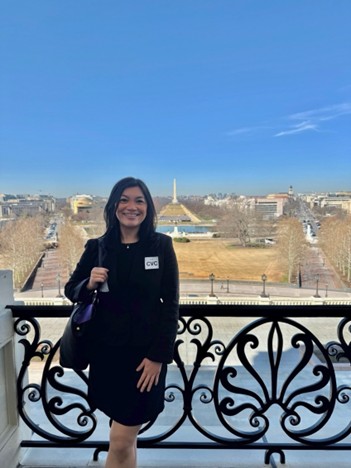
Negia standing at the Speakers Balcony at the Capitol during her lobbying visit with Montana Government officials, as the Montana Representative in the ACOG District VIII Medical Student Advisory Council.
“This project taught me to pay attention to what patients are telling us—and what the literature isn’t. Both are equally important,” she shared. “As a physician, I want research and advocacy to both be part of how I care for patients, not as something separate, but as something that strengthens the trust we build,” she said.
By confronting gaps in the evidence and translating limited data into meaningful insights, Negia’s work exemplifies how medical research can, and should, drive more equitable, patient‑centered care for overlooked communities. And for Negia, this project is just the beginning.
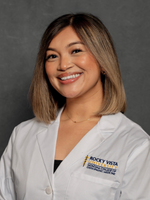 Driven by a commitment to service and equity, Negia Gamboa is passionate about advancing global health and women’s health through compassionate, patient-centered care. Her experiences have shaped a strong dedication to addressing healthcare disparities, particularly among underserved populations. Her advocacy efforts aim to promote health equity, empower communities and ensure that all individuals have access to compassionate, comprehensive care. She is especially committed to empowering women through education, preventive care and advocacy, while working to improve access to quality healthcare both locally and globally. By integrating leadership, service and osteopathic principles, she hopes to create a lasting impact in the communities she serves.
Spread the word!
- RVU-MCOM student Negia Gamboa shares how lack of data on maternal health disparities in American Indian and Alaska Native communities drove her passion for evidence-based and culturally competent care. Check out her perspective in a new feature story here.
- Medicine is more than a diagnosis—it’s about trust, culture and partnership, says Negia Gamboa, medical student at RVU-MCOM. In a new feature story, she reflects on her research project at the intersection of these ideals seeking to improve maternal health outcomes for American Indian and Alaska Native communities.
- “This project taught me to pay attention to what patients are telling us—and what the literature isn’t. Both are equally important,” shared RVU-MCOM student Negia Gamboa, reflecting on the need to help advance literature in underserved communities to improve health outcomes. In a new feature story, she shares her perspective helping shape informed practices to improve health for American Indian and Alaska Native mothers in her community.
- Driven by culture, connection and care, Negia Gamboa is charting a path toward more inclusive, patient-centered medicine. In a new feature story, Negia reflects on her experience leading a research project to help improve maternal health outcomes in American Indian and Alaska Native communities.