
Catalyzing Health and Healing through PCOM’s SHELTER Program
Published April 20, 2026
Research Stories Research Stories Report Page
When Dr. Erik Langenau, DO, MS, MAPP, discovered his eight-year-old patient hadn’t been connected with necessary social services for mental healthcare, he was angry. The child had a delayed reaction to grieving his mother, who tragically lost her life to gun violence, but the system meant to coordinate this expected care failed. Channeling his frustration into action, he was able to quickly connect his patient to essential help within days through resources he found online but wondered how many others may have fallen through the cracks.
“I was angry that the system did not serve this child well. I was [also] shocked and surprised and pleased that there were all these organizations out there to provide support when I went to look. Here I am, a pediatrician in West Philadelphia, in a highly impacted area for gun violence, and I didn't know about all these great resources,” Erik shared.
As Director for Teaching Support and Professional Development and Professor at the Philadelphia College of Osteopathic Medicine (PCOM) Erik was determined to learn more about the impact of gun violence directly from the Philadelphia community and better connect families to necessary resources.
To accomplish these dual goals, Erik and his team conducted a study to investigate community members experiences around gun violence and initiate an education program to improve doctor-patient communication on the topic. Their new educational programming for physicians provided handouts and posters, held presentations designed to coach clinicians on how to approach the topic, offered prevention strategies and local resources for support and mental health as well. He trained students to administer an oral survey of patients at PCOM’s three family medicine centers to open dialogue, build relationships in the community and teach students to sensitively and respectfully communicate about gun violence.
The results were astounding. Nearly 65% of the families had reported that they were affected by gun violence, either by witnessing a shooting, being shot themselves or losing of a loved one. The survey team gained insight from simply asking families about their experiences. Many respondents expressed relief at the opportunity to share their stories. Making space for the community’s stories of loss and survival became a powerful call to action.
Video sharing findings behind the JOM study that investigated community perceptions of gun violence in the PCOM community.
When Michelle Lent, PhD, Chief Research and Science Officer and Professor at PCOM, heard about Erik’s findings, she reflected back to her training at an urban hospital in North Philadelphia where she witnessed the impact of gun violence on a daily basis. “I was moved to help the people around me,” she shared.
“That was sort of our wake-up call to think about what we can do next,” Erik said. The pair felt an urgency to better address the multifaceted issue of gun violence in their community and founded the SHELTER Program at PCOM.
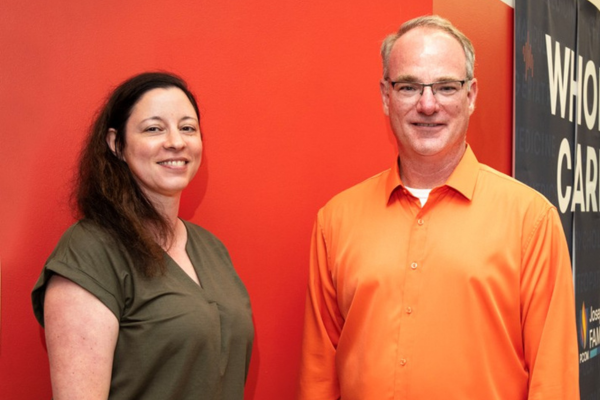
Michelle Lent (left) and Erik Langenau (right).
SHELTER stands for: Support and Healing through Empowerment, Learning and Trauma Education in Recovery. Its mission is two-fold: to educate healthcare professionals and future physicians on effective communication about issues around gun violence and to broaden access to mental health services for those affected.
“When you approach a public health crisis like this one, you have to consider the social, the cultural, the socioeconomic, the psychological, the physical, the environmental factors. All of those play a really important role in finding causes and then the solutions to reduce gun violence and its impacts on people. There's not going to be one single solution to this issue. There's going to be many. And I think the osteopathic perspective helps us understand that complexity of the issue, so that we can have a big impact on addressing the effects of gun violence,” Erik shared.
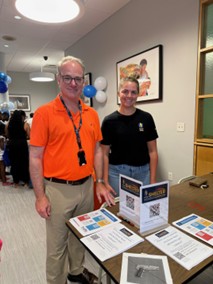
Erik and PCOM student sharing resources for the SHELTER Program.
Using the preliminary findings from the oral survey, the team earned a grant from Pennsylvania Commission on Crime and Delinquency for more than $715,000 to advance programming to support individuals impacted by gun violence.
SHELTER's educational arm has created seminars, handouts and events designed to teach clinicians how to communicate effectively about gun violence, assess those impacted and connect individuals to valuable resources. Through their planned “standardized patients”—actors trained to simulate real-world scenarios—program, students will also have the opportunity to hone their skills and ensure seamless care for patients in the real world.
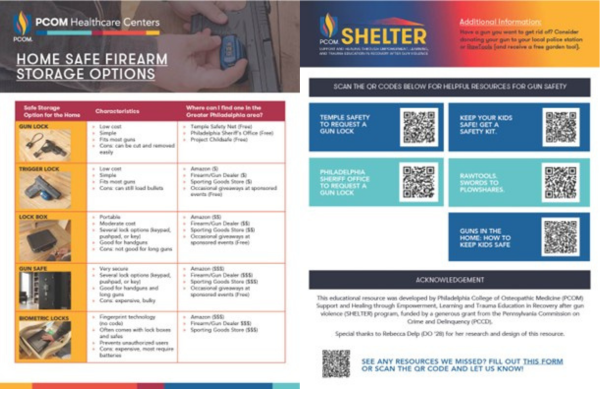
The informational handouts the team has created have helped align resources on topics like safe firearm storage and resources, as seen in the flyer above, in simple language.
Perhaps the most transformative aspect of SHELTER’s programming is the no-cost cognitive behavioral therapy (CBT) program. Delivered at PCOM’s healthcare centers, the CBT program will offer community members six sessions led by clinical psychologists and help them reclaim agency in their recovery.
“The CBT program is going to focus on helping individuals process the trauma and then learn new coping skills as they move forward. We're excited, because [through our grant funds] it's available for free. We're hoping to get 100 people over three years to really help in the community with this epidemic,” shared Michelle.
Partnerships are central to SHELTER’s vision. Through these relationships, SHELTER is creating reciprocal networks for information sharing to align resources and reduce gaps in services.
"An advantage we have at PCOM is that our healthcare centers are embedded in communities that already have a pretty strong level of trust. [Our community members] all know that students will see them when they come to the office. So, having an already established presence that is a trusted resource for them in the community, makes it a little bit easier for us to broach this really sensitive topic,” Erik shared.
One partner, Up the Block, provides offers a repository of resources for legal assistance, mental health support, relocation services and more to help survivors, families and victims after experiencing gun violence. Another, Survivor Connection, helps families share their stories with the media through The Trace, a national organization documenting the impact of gun violence. Recently the SHELTER team collaborated with Soul Shots Portraits Project, which helps memorialize the lives lost to gun violence through art. This year, portraits were installed at PCOM, each accompanied by a family-written narrative and artist context. The exhibition provided a powerful moment of reflection for students, faculty and patients alike—a reminder of the human stories behind the statistics.
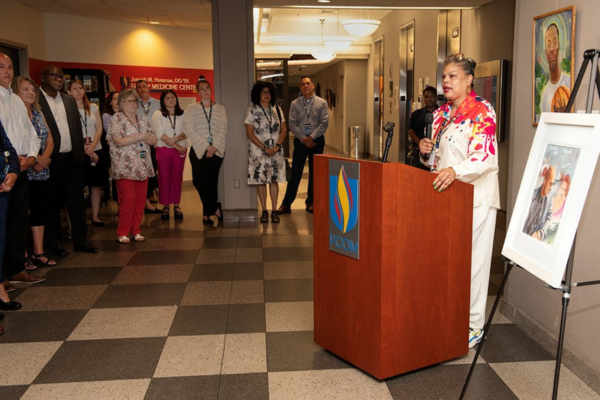
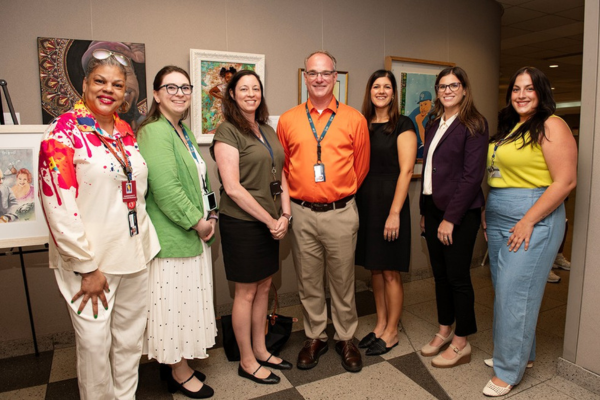
Soul Shots Reception in August 2025.
At the reception, Michelle recounted how the Soul Shots exhibition created profound connections, allowing the community to honor loved ones and heal, sharing, “one family who came to the healthcare center for regular treatment stopped at one of the paintings because they had actually known the individual in the painting. They took a moment, and they spent some time with [the portrait] and they called the family to tell them about their experience."
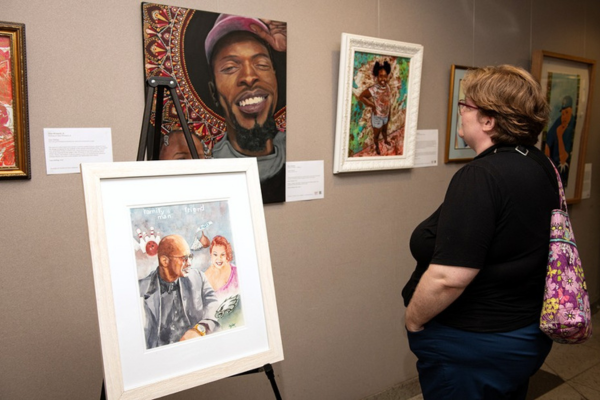
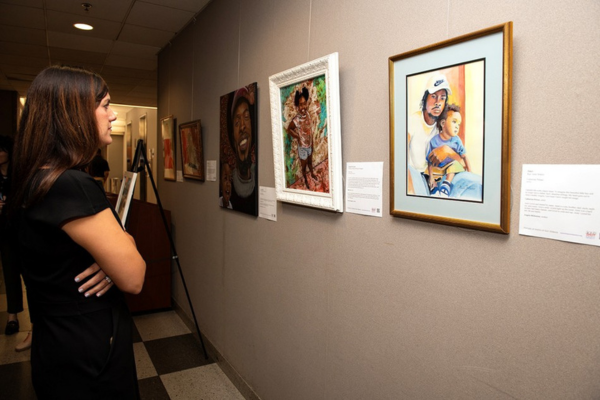
Community members engaging with the Soul Shots portraits.
As this new phase of the SHELTER project advances, the team looks forward to cultivating new partners to increase awareness and opportunities for their community. “We're consulting with and partnering with various advocacy organizations that work directly with survivors and families. Although we are still early in the process, I can tell you that the reaction from our community organizations has been enthusiastic and supportive,” said Michelle.
SHELTER’s efforts have captured interest from state leaders. In October 2025, Erik was appointed to the newly re-established Pennsylvania Office of Gun Violence and Prevention Executive Committee to bring his expertise to the cross-sectoral team at the intersection of prevention, data and social services to reduce gun violence incidents and expand resources for affected families.
This partnership has already helped created additional opportunities for shared learning and connection, through the development of a monthly webinar series Armed: Strategies to Address the Impacts of Gun Violence. This event series convenes a cross-sectional group of clinicians, psychologists, social workers and more practioners to support trauma-informed care and address the lasting mental health challenges individuals and families may face.
A shared resolve to improve lives helped form the SHELTER and it is also the drive that keeps the program pushing for more. The team hopes to scale the program beyond PCOM and help align resources and strategies across the greater Philadelphia area. In time, they also look forward to applying SHELTER model in other communities to curb the national epidemic of gun violence using evidence-based practices and local engagement.
For now, the growing SHELTER program is building its network of advocates determined to help families and communities heal.
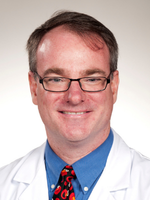 Dr. Langenau received his BA with distinction in Biology from Cornell University, his D.O. from New York College of Osteopathic Medicine, his MS in Learning Technologies from the Department of Education at Drexel University, and his M.S. in Applied Positive Psychology from the Philadelphia College of Osteopathic Medicine. He currently serves on several local and national committees. His research and educational activities have involved professionalism, genetics, competency assessment, clinical skills testing, continuous professional development, learning technologies and gun violence. Dr. Langenau remains active in clinical medicine, caring for patients and precepting medical students at the Philadelphia College of Osteopathic Medicine (PCOM).
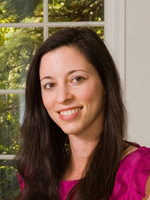 Dr. Lent received her PhD in clinical psychology (health emphasis) from Yeshiva University and completed her pre-doctoral internship and post-doctoral fellowship in behavioral medicine at Temple University Hospital and the Temple University Center for Obesity Research and Education (CORE). Her research and clinical interests include the cognitive-behavioral treatment of opioid use disorder, obesity and binge eating disorder, as well as psychosocial outcomes in individuals using medical marijuana.
Spread the word!
- Through physician education and mental healthcare, PCOM’s SHELTER Program is transforming how communities in Philadelphia heal from gun violence. In a new story learn more about how the program is cultivating resiliency and hope.
- A new program at PCOM is helping Philadelphians heal and process trauma from gun violence through community engagement, resource alignment, education and mental healthcare. See how the SHELTER Program is improving health for families and victims of gun violence.
- “There's not going to be one single solution to [gun violence]. There's going to be many. And I think the osteopathic perspective helps us understand that complexity of the issue, so that we can have a big impact on addressing the impacts of gun violence,” says Dr. Erik Langenau, DO, MS, MAPP, Director for Teaching Support and Professional Development and Professor at PCOM. Learn how his community-based research catalyzed action through the SHELTER Program to help Philadelphians heal after experiencing gun violence.
- A new program is helping the Philadelphia community address the impacts of gun violence through community engagement, physician education and mental healthcare. Learn how PCOM’s SHELTER Program is cultivating hope and resiliency in a new feature story.