.png?sfvrsn=12201194_0 "v2 clinEd accelerator background")

No coding experience required
Participate individually or with a team
Work around your own schedule
Which Clinical Education Challenge Will You Take On?
Clinical education is evolving rapidly, but persistent challenges around rotation site shortages and qualified preceptors require new thinking. We want to give you the tools, resources and guidance to strengthen your ideas and build a better future.
Choose one of five challenge areas:
Clinical sites are increasingly capacity-constrained and financially pressured, and many struggle to integrate students in ways that clearly support care delivery.
WHAT PARTICIPANTS WILL TACKLE
Design concrete roles, training modules, supervision models and value measures that that sets the stage for a clinical educational model that prepares osteopathic students for the changing landscape of healthcare while allowing them to contribute meaningfully to care teams from the beginning of medical school, especially in population health, digital health, patient navigation, quality improvement, documentation support and community-facing care. Define value at the site level, since sites differ and commit to at least one measurable patient- or care-level outcome.
A winning solution might look like: A “Day-One Value Playbook” student role descriptions, training requirements, supervision protocols and a simple ROI case that a COM and one clinical partner could pilot within a single semester.
Most COM clinical site relationships are still transactional placement arrangements, a structural mismatch with what both sides need. Sites want strategic partners that reduce administrative burden, support workforce development and improve care; COMs need partners that reinforce osteopathic identity and make clinical training sustainable. Almost no one has designed a model that delivers on both sides.
WHAT PARTICIPANTSWILL TACKLE
Design a pilotable COM–clinical partner model that moves beyond student placement and creates measurable value for both sides. Treat faculty as a shared asset across the continuum: partnerships that blend UME and GME faculty model the continuity the system now lacks and expand teaching capacity rather than competing for it.
A winning solution might look like: A partnership blueprint for a COM and one clinical partner, value proposition, shared metrics, governance structure, operating model and first-year implementation plan.
The student journey remains too time-bound and too limited in how it recognizes differentiated mastery, prior experience, professional identity and career-ready credentials.
WHAT PARTICIPANTSWILL TACKLE
Design one part of a mastery-based osteopathic pathway: competency checkpoints, real-time feedback, stackable credentials, advanced standing for experienced clinicians, inclusive entry points, professional identity formation or dashboards that signal when a learner is ready to advance. Participants may focus on one phase, one learner population or one transition point (including admissions), as long as the solution shows how readiness is defined, assessed and acted upon. Three expectations sharpen this track:
Professional identity formation: Where you address leadership or values, frame it as professional identity formation grounded in osteopathic medicine’s mission to the underserved, a construct that translates into assessable behaviors.
Credentials need a named receiver. Any stackable-credential solution must identify who accepts the credential (residency program directors, employers or licensing bodies) and the receiver-side problem it solves, so participants don’t design badges no one recognizes.
Faculty alongside learners. A competency-based journey cannot run on a time-based, under-prepared faculty. Show how your solution upskills or assesses faculty in parallel with learners, ideally blending UME and GME faculty to model continuity and expand bandwidth.
A winning solution might look like: A workable prototype for one phase or transition, showing concretely how readiness would be defined, assessed and acted upon, that could be piloted at one COM within an academic year.
AI, ambient documentation, telehealth and algorithmic decision support are reshaping clinical practice faster than medical education can comfortably adapt. Frame this offensively: as AI absorbs much of the cognitive work of differential diagnosis and documentation, what is the irreducible — and distinctively osteopathic — contribution of a physician?
WHAT PARTICIPANTSWILL TACKLE
Define how osteopathic training prepares learners to be the trusted human interface between patients and technology, clinically capable, digitally fluent, ethically grounded and emotionally intelligent. Design for the post-AI scope of practice, not the pre-AI one and anchor on two distinctively osteopathic contributions: the palpatory exam as an unautomatable interface and clinical reasoning and judgment exercised through an osteopathic lens over AI output. Center skills on critical appraisal of AI output and orchestration of agentic workflows, not prompt-crafting, which is already dated, with technology positioned to support, never replace, the physician. Solutions might include an ambient-documentation workflow, an AI-use curriculum, a patient-communication and trust protocol, an AI-enabled clinical workflow, a training simulation or an AI-output review tool.
A winning solution might look like: A prototype curriculum, credential, clinical workflow or patient-facing tool that demonstrates the DO role as the trusted human presence in AI-enabled care.
OMM is central to osteopathic identity, but its future influence depends on making its clinical value visible, measurable and practical in modern care delivery. A real barrier sits underneath this: students often disengage from OMT, especially in front of MD preceptors because they have been taught too many approaches and lack a confident, basic repertoire.
WHAT PARTICIPANTS WILL TACKLE
Design an OMM-centered clinical model for one or more high-yield conditions, such as low back pain, headache, pregnancy-related pain, post-operative recovery etc. Anchor the model on a small set of basic, high-confidence OMT assessments and treatments that every student can perform comfortably and address patient outcomes, workflow integration, learner experience, preceptor and faculty readiness (including comfort in mixed MD/DO settings) and sustainability.
A winning solution might look like: A practical OMM service-line prototype for one target condition, a clinical workflow, the basic student skill set, a patient-facing explanation, and a credible answer to how the model sustains itself (reimbursement, value-based alignment, employer interest or partner support). A working answer to the sustainability question is the essential test.
What Exactly Will I Do?
You don't need to know how a hackathon works. Here's the ClinEd Accelerator in four steps:
- Register. Sign up individually or with a team. No team? We will help connect with other participants through the Accelerator.
- Choose a challenge that matters to you. Select one of the five challenge areas and identify a problem or opportunity you want to address.
- Develop your solution, on your schedule. Use the six-week Accelerator to turn your experience, perspective or idea into a thoughtful, well-developed proposal. Plan for about 1–2 hours per week, increasing to 3–4 hours in the final weeks, with optional mentorship and resources available along the way.
- Submit and pitch your solution. Bring your work together in: A concise project page and three-minute video; additional documents/artifacts are optional.
Cash Prizes
Winners of the ClinEd Accelerator will earn from a prize pool of $10,000 with the following breakdown:
- Grand Prize - $5,000
- Second Place - $2,500
- Third Place - $1,500
- People's Choice - $500
- Honorable Mention - $500
Select innovations will have the opportunity to earn additional implementation and advancement funding through a sponsor pool of $70,000.
Misconceptions About Participation
“I don't have a solution yet.”
That's okay. Start with one of the five challenges and a problem you care about. You can develop your solution during the Accelerator.
“I'm not technical.”
You don't need to be. No coding or technical expertise is required. Solutions can focus on education, clinical practice, partnerships, processes, technology, assessment, workforce development or something entirely new.
“I don't have a team.”
You don't need one. Register individually, participate independently, join with colleagues, or elect to be matched with other participants.
“I don't have time for a six-week program.”
The six weeks are your development window, not a six-week course. Work on your solution when it fits your schedule, with optional mentorship and resources along the way. Most participants can expect 1–2 hours per week, increasing to 3–4 hours in the final weeks as they refine and complete their submission.
Still Have Questions?
Curious about the ClinEd Accelerator but not sure whether it's right for you?
Check out our ClinEd Accelerator Information Session, where we explain the five challenges, what participation looks like, what you'll submit, team options, mentorship, time commitment, prize funding and answer your questions.
For Participants
AACOM is partnering with BeMyApp, a global leader in innovation challenges, to run the ClinEd Accelerator. BeMyApp provides the virtual platform, collaboration tools and participant support throughout the event. Hear from BeMyApp about what a hackathon is and get an overview of the Accelerator platform.
Key event communications and updates about the ClinEd Accelerator will be sent from bemyapp@aacom.org. Be sure to add the address to your safe sender list to avoid missing any announcements.
Yet, as demand for physicians focused on whole-person health grows, clinical training capacity has not kept pace, creating a critical bottleneck in the medical education pipeline.
The shortage of clinical rotation sites and qualified preceptors has intensified competition among osteopathic, allopathic, nursing and physician assistant programs while increasing administrative complexity and costs for institutions. These challenges are especially significant in rural and underserved communities, where the need for well-trained physicians is often greatest.
We must urgently reform clinical education to ensure our communities get the skilled clinicians they need.
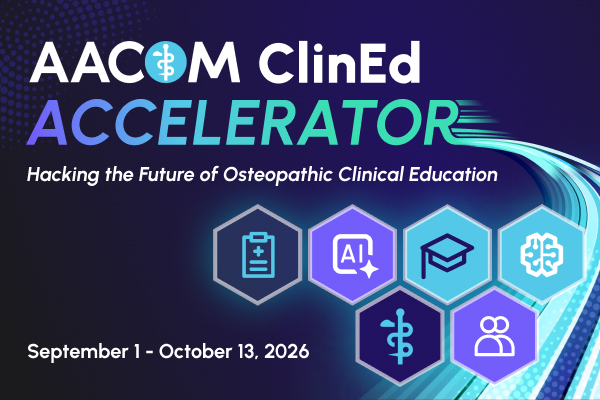
To kick-start solutions, AACOM's UME-GME Task Force created the ClinEd Accelerator, a six-week virtual hackathon designed to bring competitors across sectors, disciplines and communities to develop solutions for some of the most pressing challenges facing clinical education.
Sponsorship Opportunities
Partner with AACOM to help advance the future of osteopathic clinical education!
The AACOM ClinEd Accelerator offers organizations a unique opportunity to support innovation while connecting with educators, students, administrators, clinical partners, and healthcare leaders from across the country. Sponsors receive recognition throughout the six-week virtual experience and demonstrate their commitment to strengthening clinical education and the future physician workforce.
Help your peers discover the AACOM ClinEd Accelerator! Student Ambassadors share the opportunity through social media, student organizations and digital networks using a personalized referral link—and have the chance to earn a gift card for completing the program.
Indicate your interest during registration to learn more.
AACOM Clinical Education Think Tank
The AACOM Clinical Education Think Tank released a series of recommendations to envision a new era of clinical education that shapes emotionally intelligent, competent physicians that produce better health outcomes for their patients.
Thank You to Our Sponsors!
Founding Sponsor
Presenting Sponsor
Founding Sponsor

Track Sponsor
Progression by Mastery
Founding Sponsor
.png?sfvrsn=70235b1c_0 "medtrics (2)")
Track Sponsor
DOs as the Human Interface in AI-Enabled Care
Founding Sponsor

Track Sponsor
From Rotation Sites to Strategic Partners
Founding Sponsor
.png?sfvrsn=7f48ee23_1&MaxWidth=580&MaxHeight=380&ScaleUp=false&Quality=High&Method=ResizeFitToAreaArguments&Signature=CDA7046120F5B8C64D66CF564FDF78D77823BD0D "OHF 1 (1)")
Track Sponsor
OPP/OMM as a Measurable Clinical Service Line
Supporting Sponsor

Session Sponsor