
2026 Osteopathic Medicine Research Report
Explore trends in research activities from colleges of osteopathic medicine (COMs) and strategic recommendations to expand the distinct, community-based research innovations generated at COMs across the country.
Colleges of osteopathic medicine (COMs) have a unique role in academic research and growing capacity to address the nation’s most pressing health challenges.
COM research expands the reach of the national research enterprise into communities and clinical settings that are often underrepresented in traditional academic medical centers, generating highly impactful insights for communities with the highest needs for care.
To understand the landscape, capacity and impact of COM-affiliated research, AACOM conducted a three-part study, titled Research at Colleges of Osteopathic Medicine: Inventory, Analysis and Future Directions, to:
- Inventory active research projects at COMs,
- Examine recent publications and dissemination patterns and
- Identify and analyze sources of extramural funding.
Together, these analyses offer a comprehensive picture of the state of COM research—and a roadmap for strengthening its future.
COM-affiliated research can include but is not limited to:
- Research coming out of the 43 COMs or 70 teaching locations across the country.
- Investigations undertaken by DOs or osteopathic medical students.
- Examinations of osteopathic manipulative medicine (OMM) or osteopathic manipulative treatment (OMT) and its applications.
- Studies on the osteopathic medical workforce and education, including practitioners, students, faculty, applicants and more.
- Research in and from clinical training rotations and residency programs with osteopathic recognition.
- Research conducted through a distinct osteopathic perspective.
Research at COMs is community-engaged by design, making it uniquely suited to address real-world health challenges and contribute meaningfully to the national research landscape. This report marks the first time our community’s impact has been measured at this scale—and it shows a field ready to play a much larger role in improving health for all.
— AACOM President and CEO Robert A. Cain, DO
Key Findings
Explore high-level takeaways from the 2026 COM Research Report.
Report Recommendations
Review tactics by priority area to improve the environment for COM research
Shaping Transformative Care
Hear how our community is advancing research that shapes better health
Advancing the Field
Discover how AACOM is addressing priorities for osteopathically aligned research
Key Findings
COM researchers are uniquely positioned to address healthcare's most pressing concerns by prioritizing community-focused approaches that advance research in primary care, rural health and prevention to transform care delivery for those most in need.
Advancing Community‑Engaged Research to Improve Health Across the Nation
The U.S. faces widespread challenges from chronic illnesses (such as hypertension, kidney disease and diabetes), reduced access to care due to physician shortages and barriers (social, structural and economic) that inhibit health and well-being. There is a pressing need for innovative medical solutions tailored to the realities of healthcare, particularly for vulnerable populations, to promote health and well-being for all.
COM-affiliated research represents a distinct pipeline for scientific inquiry that both aligns with national health priorities and draws upon values of osteopathic medicine: holistic approach to medicine, community-engaged care in rural and underserved areas and strong presence in primary care.
Through their community-based models of medical training, high numbers of COMs are concentrated in rural and underserved areas, providing deep connections to diverse regions, healthcare settings and populations that can most benefit from innovations in medical care.
This pathway expands opportunities for academic research, complementing and augmenting traditional pathways concentrated in large medical centers and health systems.
Click to expand the figures below.
COM Research Inventory: AACOM distributed the Osteopathic Research Inventory survey in 2025 to 42 COMs. Main campuses reported data for all affiliated campuses. Participating institutions reported their extramurally funded research activities. Thirty-one COMs responded (74%). A total of 30 complete responses (72%) were analyzed, with one incomplete response excluded from the analysis. The dataset was comprised of 611 research projects and 342 unique principle investigators.
Bibliometric Survey: AACOM’s five-year bibliometric study (from 2020–2025) examined publication patterns, citation metrics, journal distribution, authorship roles and dissemination trends among COCA-accredited COM-affiliated researchers. The dataset, retrieved using metadata from OpenAlex, was comprised of 32,877 publications disseminated at 3,738 academic journals.
Extramural Funding Analysis: This funding analysis used data from the AACOM Annual Survey (Academic years 2021-2024) to identify NIH-funded grants COMs applied for and received over the previous five years and a breakdown of applications and awards by NIH Institute or Center to identify both systemic barriers and underutilized federal opportunities aligned with osteopathic research strengths. Forty-three COM main campuses were reflected in dataset.
Learn more about our methodologies in the 2026 COM Research Report.
COM Research Inventory
AACOM’s Research Inventory captures a high-level overview of the current state of COM-affiliated research.
Research at COMs is driving innovation in rural and underserved regions and concentrating in domains aligned with osteopathic philosophy, such as health services primary care, rural health and medical education—all areas that are underrepresented in the broader academic research landscape. A searchable database for projects informing this research inventory is available here.
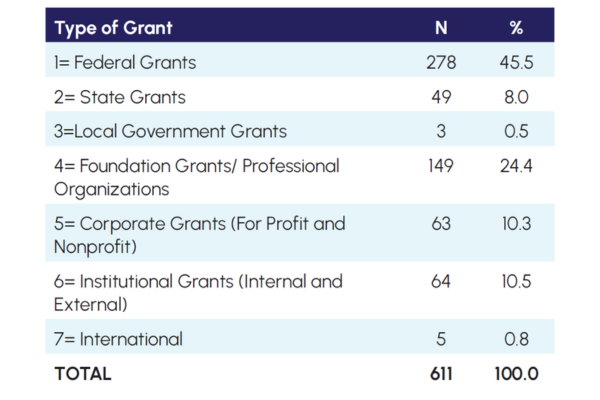
Total frequency and percentage of projects by type of grant
COM-Affiliated Research Landscape
Of the 611 funded research projects included in the research inventory, 45.5 percent (278) were federally funded and 24.4 percent were supported by foundation grants/professional organizations.
The highest concentrations of extramurally funded research projects came from MSUCOM (at 33.2 percent) and Rowan-Virtua SOM (all campuses at 18.5 percent)
Research Domains
COM research activity is strongly aligned with national priorities.
Focus areas include basic science, neuroscience, mental and behavioral health, medical education, workforce development and care for rural and underserved populations.
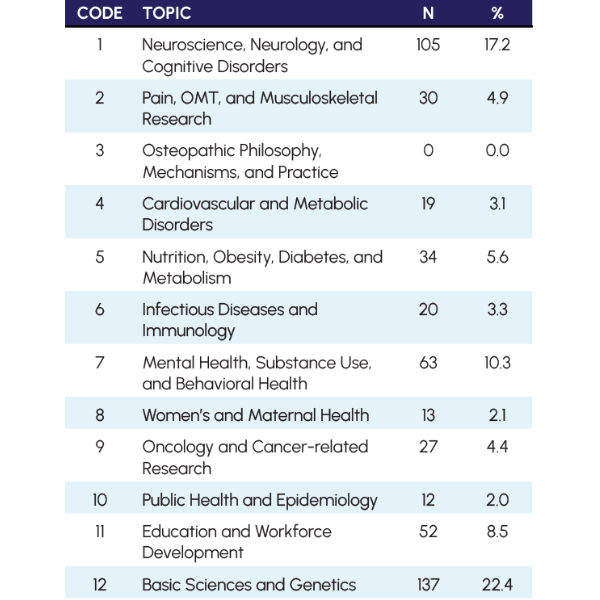
The basic sciences and genetics category was the most common topic, comprising 22.4 percent of all projects, followed by neuroscience, neurology and cognitive disorders (17.2 percent) and mental health, substance use and behavioral health (10.3 percent).
MSUCOM leads the COMs in two categories of projects: 1) basic sciences and genetics and 2) neuroscience, neurology and cognitive disorders, while Rowan-Virtua SOM (all campuses) leads the COMs in the total number of mental health, substance use and behavioral health projects.
Research topics overall total and percentage
Faculty Research Engagement
COM faculty are leading extramurally funded projects across diverse domains, highlighting the representation of osteopathically aligned researchers meaningfully contributing to the medical knowledge base.
There were 342 unique principal investigators identified across the COMs. PhD investigators account for the majority of the total investigators at (413) 67.8 percent. Physicians, both DOs and MDs, are the second largest group at 25.1 percent (153). The remaining 7.1 percent of investigators are comprised of allied professionals including educators, public health professionals, veterinarians and pharmacists.
The highest proportion of unique investigators was 22.5% at Rowan- Virtua SOM- (all campuses) followed by 19.6% at MSUCOM.
The distribution of principal investigators by type of degree for all COMs

Bibliometric Survey
AACOM’s Bibliometric Survey highlights dissemination trends in published work affiliated with COMs.
COM-affiliated researchers publish actively, in a wide range of institutions, topics and journals, with concentrated outputs among COMs and dissemination types.
TOTAL
WORKS
32,877
TOTAL PARENT
CAMPUSES
45
COM
AUTHORS
34,223
AVG. AUTHORS
PER WORK
7.14
AVG. COM AUTHORS
PER WORK
2.16
MULTI-CAMPUS
WORKS
1,799
COM-Affiliated Publications
COM-affiliated research produced 32,877 publications produced between 2020 and 2025 and disseminated across 3,738 unique academic journals.
The overall volume of COM-affiliated publications has increased steadily over the study period, reflecting a sustained expansion of research activity across institutions.
Publication activity is concentrated among a small number of institutions and investigators with an established track record of research activity.
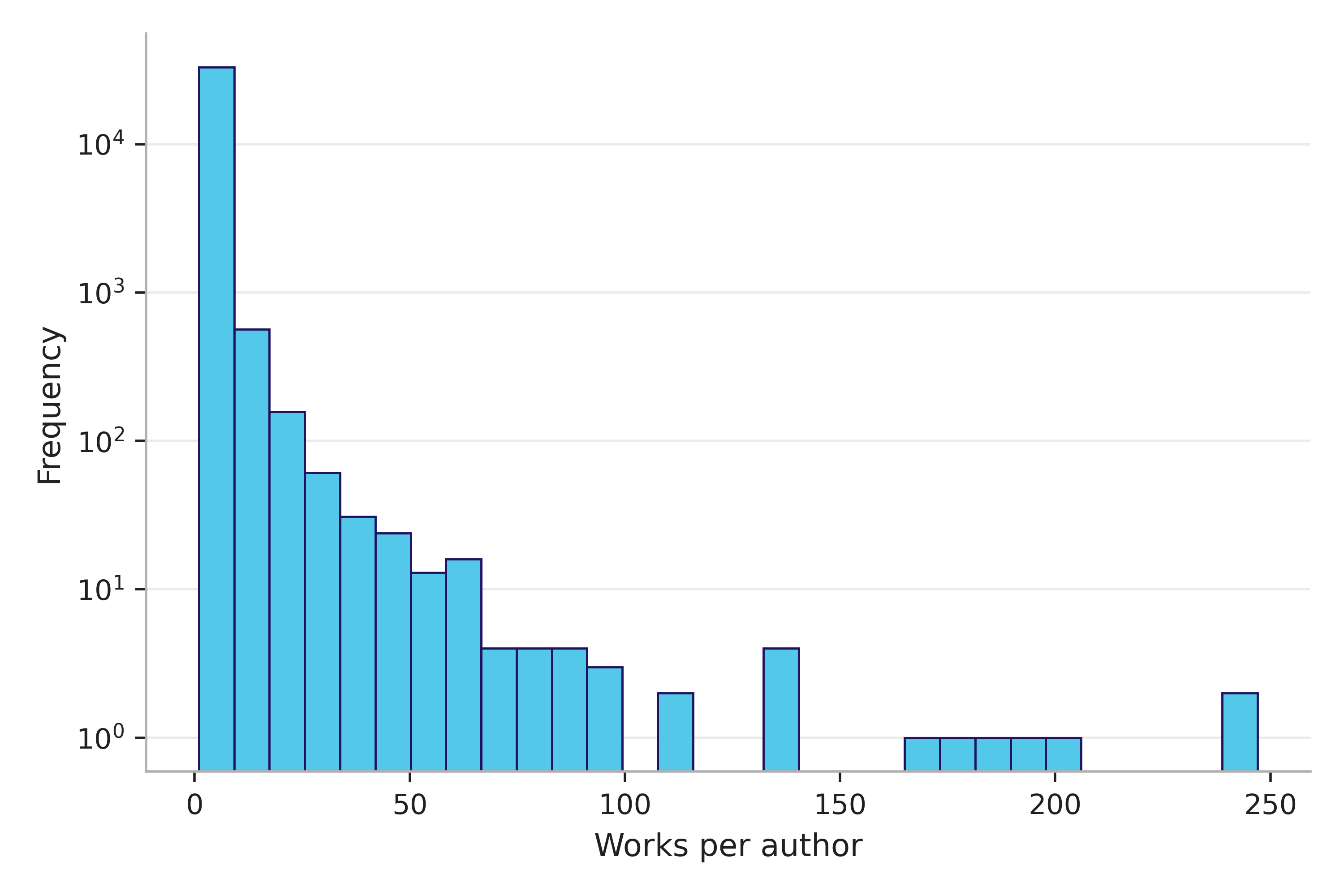
While nearly 70 percent of authors in the corpus appear on exactly one work, fewer than three percent of authors appear on 10 or more works.
Distribution of Publications per Author
Publication and Dissemination
Research scale and research visibility are partially independent at COMs.
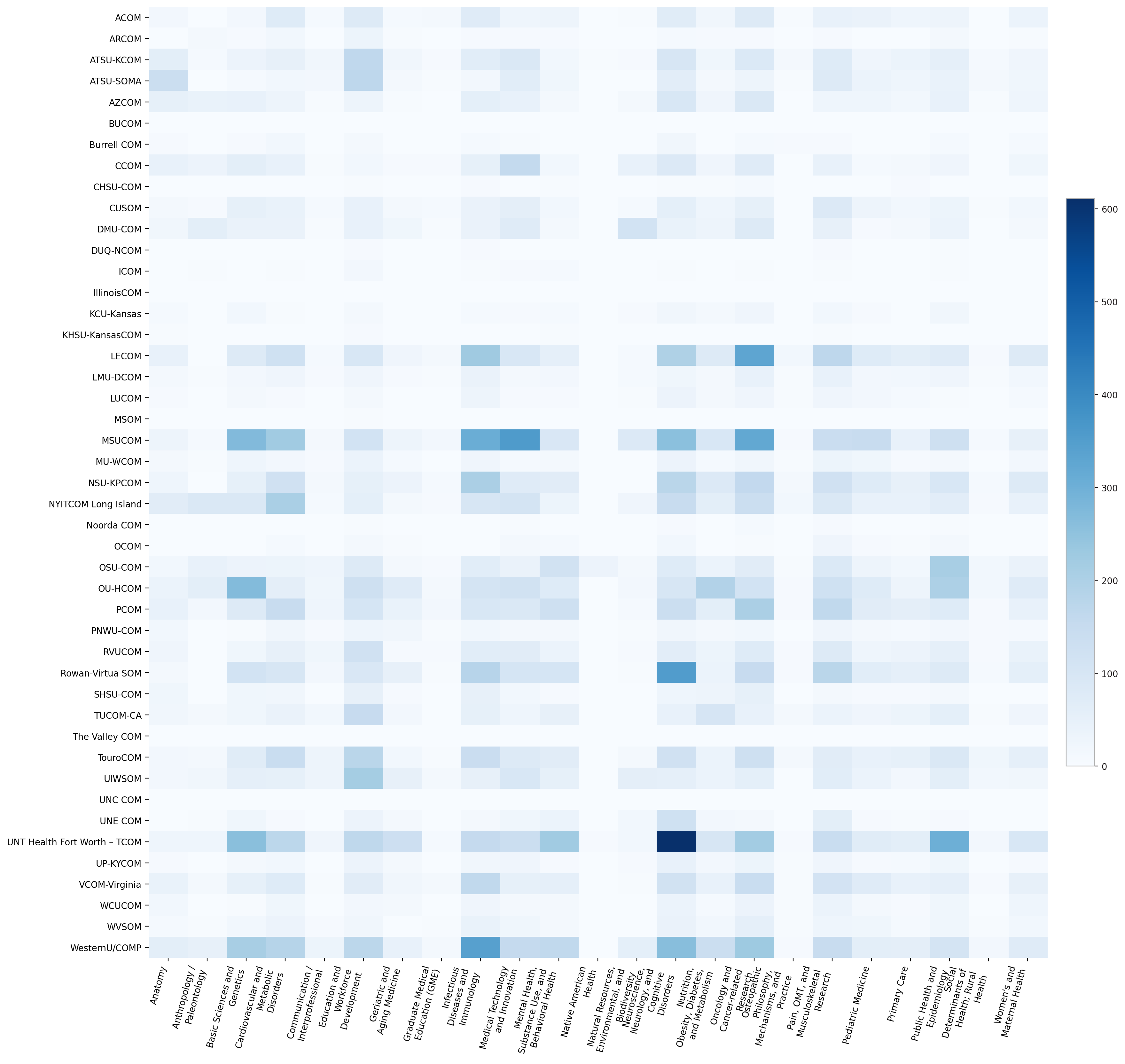
COMs have distinct institutional profiles, with some COMs operating as high-output, research-intensive hubs and others placing work more effectively into higher-visibility scientific conversations.
Distribution of Research Topics by COM
Among COMs, the top five schools and their campuses account for 37 percent of all unique works.
The top 10 schools cover more than 61 percent of the publications.
Distribution of Publications by Colleges of Osteopathic Medicine (Top 15 Institutions)
.png?sfvrsn=9ac580a0_4 "Figure 2. Distribution of Publications by Colleges of Osteopathic Medicine (Top 15 Institutions)")
Institutional context plays a meaningful role in shaping how much research is produced and what kind of research is pursued.
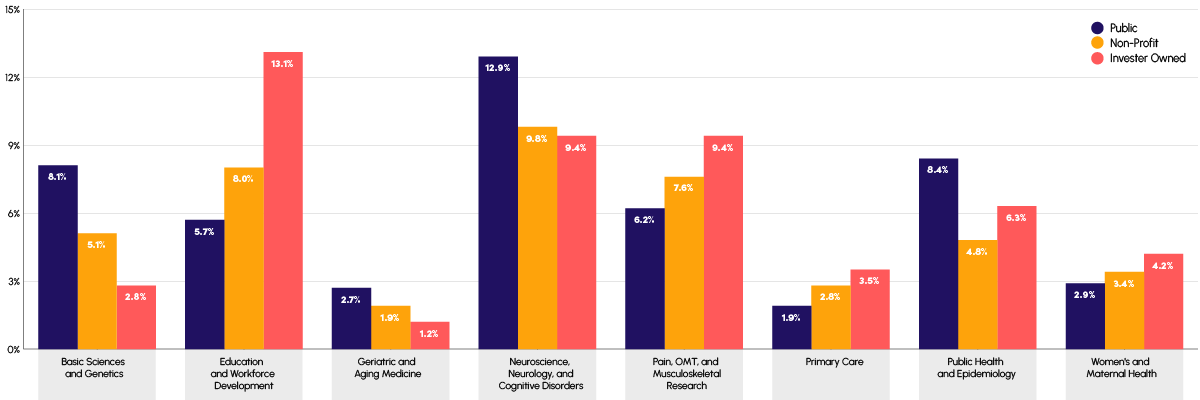
University-affiliated COMs show greater representation in biomedical and laboratory-oriented domains, while other COM types demonstrate relatively stronger representation in clinically oriented or educational research areas.
Distribution of Research Topics by COM Type
COM research is dispersed across mainstream biomedical venues.
Publication in a subset of journals shows publication volume and impact do not necessarily align. Some journals with relatively modest representation in the corpus show substantially higher citations per publication, while some high-volume outlets contribute less to citation accumulation on a per-paper basis.
Citation Impact of High-Volume Journals (_50 publications), Ranked by Mean Citations (Top 12)
-ranked-by-mean-citations-(top-15).png?sfvrsn=a4638711_5 "TABLE 6. Citation Impact of High-Volume Journals (_50 publications), Ranked by Mean Citations (Top 15)")
Publication Domains
COM-affiliated publications are widely distributed across major areas of medicine and health science, highlighting their integration with the general biomedical research ecosystem.
The category of neuroscience neurology and cognitive disorders accounts for approximately 11 percent of publications, followed by oncology and infectious disease at 9.7 percent. Musculoskeletal and pain-related research, including osteopathic manipulative treatment (OMT), represents a smaller but still meaningful portion of the portfolio at approximately seven percent.
Research areas such as oncology, molecular biology and neuroscience tend to achieve higher average citation rates, while clinically oriented and educational domains, though often higher in volume, tend to have lower citation intensity.
Research Topic Positioning by Leadership and Citation Impact
COM researchers play more prominent leadership roles in some topic areas over others.
Clinically-oriented and osteopathic-focused domains tend to show stronger COM representation, while highly specialized biomedical fields may involve more participation within larger, externally led research teams.
COM Leadership Rate by Research Topic (Top and Bottom 5 Domains)
.png?sfvrsn=9ba86077_1 "Figure 4. COM Leadership Rate by Research Topic (Top and Bottom 5 Domains)")
COM research is being driven by increased output and expansion of contributor base, with leadership capacity developing more gradually over time.
COM researchers hold first or last authorship in about 60 percent of publications, comparable to a reference sample of allopathic schools (62 percent)
Trends in COM-Affiliated Publications by Authorship Roles (2020-2025)
.png?sfvrsn=94a8a297_1 "Figure 8. Trends in COM-Affiliated Publications by Authorship Roles (2020-2025)")
Funding Landscape
AACOM’s Extramural Funding Analysis highlights trends and opportunities for COM research in NIH-funding mechanisms.
COMs showcased wide engagement and success with NIH funding mechanisms.
The evidence highlighted many opportunities—across policy, strategic alignment, COM infrastructure—to expand osteopathically aligned research in these federal funding pools.
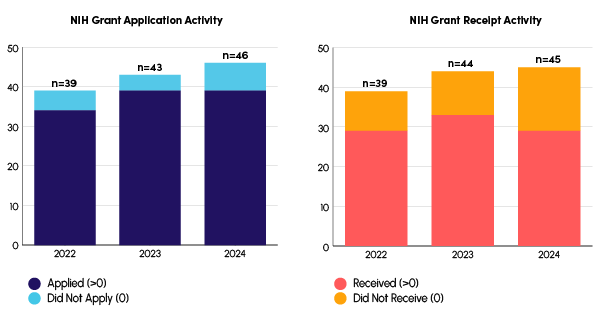
Between 85 and 91 percent of COMs reported at least one NIH grant application from 2022-2024 and between 64 and 75 percent of COMs reported at least one NIH grant award during that same period.
A total of 857 applications and 402 awards were reported across 22 NIH institutes and centers.
NIH Grant Application and Award Engagement by Survey Year, 2022–2024
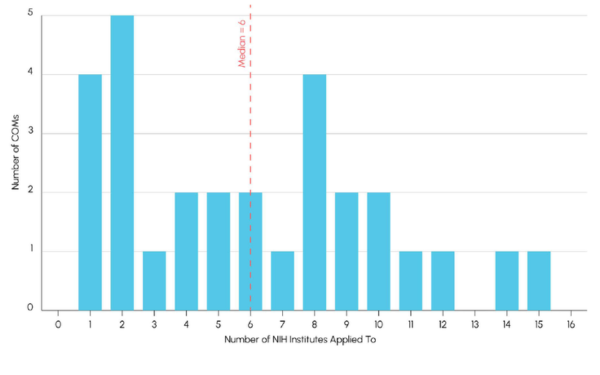
Among the 29 COMs that reported at least one institute-level application, the median number of NIH Institutes applied to was 6, with a mean of 6.1 and a range of 1 to 15.
Breadth of NIH Institute Engagement Among Active COMs, 2024
The distribution of NIH activity across COMs is highly concentrated.
The top five institutions by application volume—OU-HCOM, Rowan-Virtua SOM, WesternU/COMP, OSU-COM and UNT Health–TCOM—account for 60.4% of all institute-level applications.
While 28.3 percent of COMs reported more than 20 NIH applications, Certain COMs (15.2 percent) remain entirely outside the NIH funding ecosystem.
Top 10 COMs by NIH Grant Applications, Awards (Institute-Level), 2024
-2024.png?sfvrsn=622df7d9_1 "Top 10 COMs by NIH Grant Applications (Institute-Level), 2024")
.tmb-small.png?Culture=en&sfvrsn=9a5b0793_1 "legend (1)")
COMs align their NIH applications with institutes that support both basic science and disease-focused translational research—areas consistent with the research inventory domain findings.
National Institute on Aging received the largest number of applications (114) from 17 COMs, followed by the National Institute of Allergy and Infectious Diseases (99 applications across 15 COMs) and the National Cancer Institute (94 across 18 COMs).
NIH Grant Applications and Awards by Institute - Center, 2024
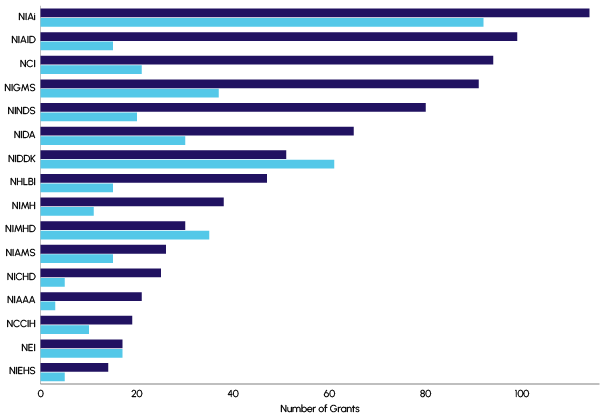
There is room for broader engagement with NIH Institutions and Centers—particularly with mission-aligned institutes, which may represent underexploited opportunities for osteopathic researchers.
Strategic reorientation toward funding mechanisms aligned with the strengths and domain areas of COM research, coupled with advocacy for greater DO representation on NIH study sections, could meaningfully expand the funding base and impact of this work. See more in the sections below.

COM Research Directory
AACOM’s COM Research Directory gathered a foundational information to establish an initial database of COM-affiliated researchers and projects.
Learn more about the research COMs across the country are leading. Connect and collaborate with researchers focusing on similar or related projects.
Strengthening the Future of Osteopathic Research
COMs are poised to shape the future of health research in ways that benefit patients, communities and healthcare at large, with high potential for impact in rural, underserved communities and primary care.
See recommendations outlined in AACOM’s 2026 COM Research Report targeted to enhance and expand COM research.
Collaboration among COMs can create a multiplier effect, leveraging diverse areas of expertise, resources, data and more through coordinated networks that build on the natural strengths of COM research. These cross-COM partnerships can create capacity for larger, multi-site studies that no single institution could achieve alone.
- Form research networks: Develop formal consortia or networks across COM campuses (similar to national collaborative models) to jointly conduct studies on shared priorities like rural health or primary care outcomes.
- Share protocols, datasets and best practices: Collaborate to achieve common research agendas or joint training programs to streamline multi-site projects and avoid duplicative work.
- Coordinate funding efforts: Partner on multi-institution grant applications. A united front can increase competitiveness for large-scale grants and demonstrate broader impact to funders.
- Create a known community of research sites: Establish practice-based research networks (PBRNs) that connect community clinics and training sites with COM researchers.
Mentorship and senior investigator development can be an especially powerful driver for COM research—supporting research processes, increasing publication and shaping the next generation of physician researchers.
- Invest in research support structures and services: Increase dedicated research staff and resources (like lab space, grant administration and data management/infrastructure) at COMs. Provide written and simplified guidance for research processes (ex. IRB processes for multi-site research).
- Provide protected time: Allocate faculty time specifically for research activities, which is crucial for sustaining projects and pursuing grant funding.
- Formalize mentorship programs: Pair early-career researchers and students with experienced DO or other research mentors, including cross-institution mentorship when needed, to guide project development and publication.
- Increase student research experiences: Develop both formal (longitudinal research clerkship, summer research programs with inter-COM exchange, research literacy curriculum integration) and informal (peer-support work groups, mentor matching) opportunities that connect students to the research.
- Offer professional development: Implement training in research skills, from study design to statistical analysis and manuscript writing. Regular workshops, mentor networking and grant writing bootcamps can empower faculty and trainees to excel in research. Offering programs to elevate preceptors as research collaborators can also enable students to pursue research opportunities.
- Recognize and reward research: Foster a culture that values scholarly activity by acknowledging research achievements in faculty promotions, awards and incentives.
COM-affiliated research can benefit from audience expansion, both academic and public audiences, and dissemination through formal peer-reviewed publication and visibility in high-impact channels to increase the influence of its findings and uptake of citations.
Create new peer-reviewed journal: Support development of an osteopathic medical education journals to provide a dedicated space for COM-affiliated research.
Convert presentations to publications: Provide support (writing workshops or editorial assistance) to help researchers turn conference presentations and posters into peer-reviewed journal articles, increasing the amount of COM research in permanent scientific literature.
Aim for peer-reviewed and high-impact outlets: Encourage investigators to submit work to widely-read journals and explore open-access or mainstream media avenues to share key results and success stories.
Track and celebrate research output: Establish mechanisms to monitor publication metrics and celebrate notable COM research achievements, reinforcing a culture of scholarly dissemination.
COM research can expand its visibility and capability by seeking funding from sources that align with its mission and strengths—such as primary care, workforce development and patient‑centered outcomes research—and by working to remove structural barriers in federal funding systems.
Highlight the distinctiveness of COM research: Create a formal framework that categorizes COMs as leaders in community-engaged research, primary care science and whole-person approaches to health, rather than simply competitors for traditional R01 mechanisms. Highlight COM research's distinctive contribution to the national research enterprise, insight into real-world settings underserved by traditional academic centers and the unique osteopathic philosophy that underlies its approach.
Pursue mission-aligned grants: Focus on agencies and programs who mission and vision aligns with COMs’ expertise and domains—for example, HRSA (which supports health workforce and rural health), AHRQ (health services quality and outcomes) and PCORI (patient-centered outcomes) to maximize impact and opportunity to secure funding.
Advocate for equity in research funding: Work with policymakers and national organizations to increase the presence of osteopathic physicians on peer review panels and advisory boards (e.g. at NIH). Greater representation can help ensure that research from COMs is fairly evaluated and funded.
Shaping Transformative Care Through Research
Across the country, researchers at COMs are advancing scientific inquiry through an osteopathic lens to address our nation’s health challenges. Their work is informing better care delivery, inspiring future physician scientists and shaping healthier communities.
AACOM Applauds House Hearing on Advancing the Next Generation of America’s Healthcare Workforce
IMMEDIATE RELEASE
(Bethesda, MD) – The American Association of Colleges of Osteopathic Medicine (AACOM) today commends the U.S. House Committee on Ways and Means Subcommittee on Health for convening a hearing on “Advancing the Next Generation of America’s Healthcare Workforce,” and applauds the testimony of Thomas J. Mohr, DO, vice president of medical affairs and dean of the Sam Houston State University College of Osteopathic Medicine.
“Today’s hearing highlights a fundamental truth: if we want to solve America’s physician shortage, we must align federal policy with where patients receive care,” said Robert A. Cain, DO, AACOM president and CEO. “Osteopathic medical education’s community-based, patient-centered model has a proven track record of preparing physicians to practice primary care, serve rural communities and address chronic disease through prevention and whole-person health. Modernizing Medicare GME and advancing the FAIR Act will help ensure that the next generation of physicians can train and ultimately practice where they are needed most.”
“Osteopathic medicine is grounded in a whole-person philosophy that recognizes the unity of body, mind and spirit,” said Dr. Mohr. “Our community-based model of medical education places students and residents where care is most needed, in rural communities, health centers and community hospitals. We know that physicians are far more likely to practice where they train. Strengthening and modernizing GME policy to support community-based programs is one of the most effective ways to address workforce shortages and improve healthcare access.”
Osteopathic medical education operates through a distributed, community-based training model. Today, 46 colleges of osteopathic medicine, representing 73 campuses in 36 states, educate more than 38,000 future physicians, nearly 30 percent of all U.S. medical students. More than half of DOs practice in primary care specialties, and more than 73 percent practice in the state where they complete their residency training.
Despite this strong workforce impact, Medicare’s graduate medical education (GME) financing system remains largely structured around large academic medical centers and inpatient hospital care, and legacy funding formulas that can disadvantage rural hospitals and community-based training sites. Residency caps, geographic disparities in per-resident amounts and complex administrative requirements can create barriers for smaller institutions seeking to establish new residency programs.
Dr. Mohr also underscored the importance of transparency and fairness in residency selection, highlighting the bipartisan Fair Access In Residency (FAIR) Act, H.R. 2314/S. 2715. The legislation would impose new reporting requirements on Medicare-funded residency programs to address systemic inequalities imposed on osteopathic medical students.
“The FAIR Act is a commonsense, bipartisan step toward transparency and accountability in federally supported residency programs,” said Dr. Mohr. “Ensuring fair consideration strengthens the physician workforce and helps deliver more doctors to rural and underserved communities.”
“As Congress considers reforms to GME, AACOM stands ready to work with lawmakers to expand community-based training, increase fairness and transparency in residency selection and build a physician workforce that reflects the needs of every community in America,” said Dr. Cain.
About AACOM:
Founded in 1898, the American Association of Colleges of Osteopathic Medicine (AACOM) is the leading voice for the education and training of physicians who practice osteopathic medicine in settings across the medical spectrum—from primary care to the full range of medical specialties. We support our member colleges of osteopathic medicine in their efforts to attract and train individuals who are fueled by a desire to make a difference in our healthcare system by treating the whole person and building a future emphasizing health and wellness for all people. Today, more than 38,000 future physicians—close to 30 percent of all U.S. medical students—are being educated at one of our 46 accredited colleges of osteopathic medicine, encompassing 73 teaching locations in 36 states. To learn more about AACOM, please visit our website.
Contacts:
Joseph Shapiro
Director of Media Relations
(240) 938-0746
jshapiro@aacom.org
Christine DeCarlo
Senior Manager of Media and Public Affairs
(202) 603-1026
cdecarlo@aacom.org
Advancing the Field Through Advocacy
Help AACOM advocate for medical research and innovation at COMs and improve health outcomes across communities.
AACOM is committed to improving the research landscape to strengthen high impact innovations in communities where they can make the most difference through policy, advocacy and strategic investment.
By addressing inequities in funding, broadening investment opportunities, promoting knowledge-sharing and advancing research aligned with its community needs, AACOM is helping ensure that COM research continues to thrive—and improve health nationwide.

Take Action!
Advocate for policies that strengthen medical education, expand access to care in rural and underserved communities and support innovation at COMs.
Learn MoreExplore National Funding Opportunities and Resources
Resources for Prospective
Physician-Scientists
Learn more about physician scientists, their career pathways and training programs.
Council of Osteopathic
Researchers
Join AACOM’s council for researchers and help coordinate medical education and research for future physicians.
Osteopathic Physician-Scientists Engagement
Network (OPEN)
Join AACOM’s network for physician-scientists, DO/PhD program directors and trainees.
Explore funding for ideas advancing OME through innovative, evidence-based or collaborative approaches.
Learn more about available grants, loan repayment opportunities, tips for proposal preparation and more.
SOME Innovation in
Medical Education Awards
Recognize innovation that strengthens OME from teaching and learning to assessment and leadership.
In the News
Check out noteworthy advances in research and policy seeking to improve the opportunity and capacity for COM-affiliated research.
AACOM Applauds House Hearing on Advancing the Next Generation of America’s Healthcare Workforce
IMMEDIATE RELEASE
(Bethesda, MD) – The American Association of Colleges of Osteopathic Medicine (AACOM) today commends the U.S. House Committee on Ways and Means Subcommittee on Health for convening a hearing on “Advancing the Next Generation of America’s Healthcare Workforce,” and applauds the testimony of Thomas J. Mohr, DO, vice president of medical affairs and dean of the Sam Houston State University College of Osteopathic Medicine.
“Today’s hearing highlights a fundamental truth: if we want to solve America’s physician shortage, we must align federal policy with where patients receive care,” said Robert A. Cain, DO, AACOM president and CEO. “Osteopathic medical education’s community-based, patient-centered model has a proven track record of preparing physicians to practice primary care, serve rural communities and address chronic disease through prevention and whole-person health. Modernizing Medicare GME and advancing the FAIR Act will help ensure that the next generation of physicians can train and ultimately practice where they are needed most.”
“Osteopathic medicine is grounded in a whole-person philosophy that recognizes the unity of body, mind and spirit,” said Dr. Mohr. “Our community-based model of medical education places students and residents where care is most needed, in rural communities, health centers and community hospitals. We know that physicians are far more likely to practice where they train. Strengthening and modernizing GME policy to support community-based programs is one of the most effective ways to address workforce shortages and improve healthcare access.”
Osteopathic medical education operates through a distributed, community-based training model. Today, 46 colleges of osteopathic medicine, representing 73 campuses in 36 states, educate more than 38,000 future physicians, nearly 30 percent of all U.S. medical students. More than half of DOs practice in primary care specialties, and more than 73 percent practice in the state where they complete their residency training.
Despite this strong workforce impact, Medicare’s graduate medical education (GME) financing system remains largely structured around large academic medical centers and inpatient hospital care, and legacy funding formulas that can disadvantage rural hospitals and community-based training sites. Residency caps, geographic disparities in per-resident amounts and complex administrative requirements can create barriers for smaller institutions seeking to establish new residency programs.
Dr. Mohr also underscored the importance of transparency and fairness in residency selection, highlighting the bipartisan Fair Access In Residency (FAIR) Act, H.R. 2314/S. 2715. The legislation would impose new reporting requirements on Medicare-funded residency programs to address systemic inequalities imposed on osteopathic medical students.
“The FAIR Act is a commonsense, bipartisan step toward transparency and accountability in federally supported residency programs,” said Dr. Mohr. “Ensuring fair consideration strengthens the physician workforce and helps deliver more doctors to rural and underserved communities.”
“As Congress considers reforms to GME, AACOM stands ready to work with lawmakers to expand community-based training, increase fairness and transparency in residency selection and build a physician workforce that reflects the needs of every community in America,” said Dr. Cain.
About AACOM:
Founded in 1898, the American Association of Colleges of Osteopathic Medicine (AACOM) is the leading voice for the education and training of physicians who practice osteopathic medicine in settings across the medical spectrum—from primary care to the full range of medical specialties. We support our member colleges of osteopathic medicine in their efforts to attract and train individuals who are fueled by a desire to make a difference in our healthcare system by treating the whole person and building a future emphasizing health and wellness for all people. Today, more than 38,000 future physicians—close to 30 percent of all U.S. medical students—are being educated at one of our 46 accredited colleges of osteopathic medicine, encompassing 73 teaching locations in 36 states. To learn more about AACOM, please visit our website.
Contacts:
Joseph Shapiro
Director of Media Relations
(240) 938-0746
jshapiro@aacom.org
Christine DeCarlo
Senior Manager of Media and Public Affairs
(202) 603-1026
cdecarlo@aacom.org
Related Materials
- Explore: COM Research Directory
- Members Only: AACOM Analytics
- Read: Trends in osteopathic medical education: A scoping review
- Read: Top 100 cited articles in osteopathic medical education: A bibliometric analysis
- More like this: AACOM Publications
Suggested Citation
American Association of Colleges of Osteopathic Medicine. 2026 Osteopathic Medicine Research Report. https://www.aacom.org/2026COMResearchReport. Published April 20, 2026. Accessed MM DD, YYYY.
We'd like to thank the Osteopathic Heritage Foundation
for their partnership in developing this landmark report.