
From Scranton to the Nation: Northeast Pennsylvania Offers New Model for Expanding Clinical Medical Education
Published August 19, 2026
Inside OME
Innovative partnership brings medical schools, hospitals and community organizations together to strengthen physician training, expand access to care and build the local healthcare workforce
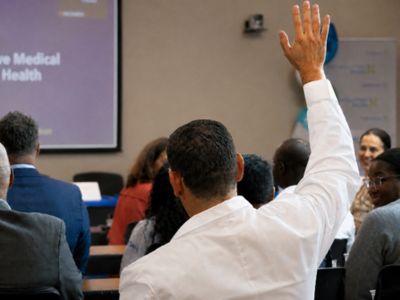
Healthcare, education and community leaders gathered in Scranton, Pennsylvania, on August 12, 2026, to spotlight an innovative approach to one of the nation’s growing healthcare challenges: creating enough high-quality clinical training opportunities to prepare the next generation of physicians.
The Northeast Pennsylvania Clinical Education Consortium (NEPA-CEC), launched in 2023, brings together colleges of osteopathic medicine, hospitals, community health organizations and local partners to expand clinical education capacity in Northeast Pennsylvania. Rather than building a new medical school or teaching hospital, the consortium leverages the region’s existing institutions and healthcare infrastructure, and a willingness of three colleges of osteopathic medicine in the region, to collaborate and create a stronger pathway from medical school to residency and, ultimately, physician practice locally.
The event, “From Scranton to the Nation: A New Model for Clinical Education,” brought together leaders from the American Association of Colleges of Osteopathic Medicine (AACOM), Lackawanna College, the City of Scranton, Philadelphia College of Osteopathic Medicine, The Wright Centers for Community Health and Graduate Medical Education, Commonwealth Health Regional Hospital of Scranton and Tenor Health Foundation, along with medical students participating in the initiative.
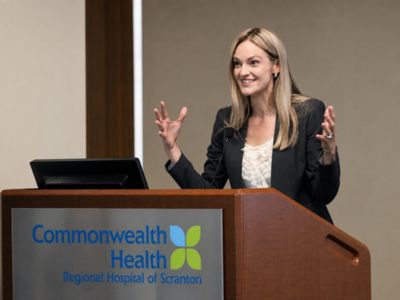 Scranton Mayor Paige Cognetti opened the event by reflecting on how the institutions that make a community thrive, from hospitals and schools to businesses and neighborhoods, are deeply interconnected. Cognetti noted that a strong region depends on all of those pieces working together, underscoring the value of the community-centered, collaborative approach at the heart of the NEPA-CEC.
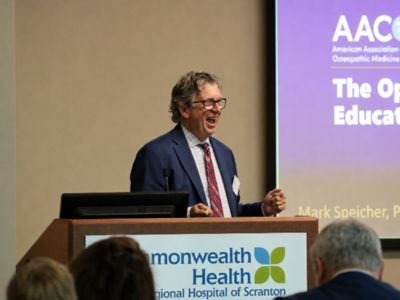 “The challenge facing medical education is not simply how many physicians we educate. It is whether we have enough high-quality places for them to train, particularly in the communities that need them most,” said Mark Speicher, PhD, senior vice president of research, learning and innovation at AACOM. “The NEPA-CEC shows what is possible when medical schools, healthcare organizations and community leaders stop competing for limited clinical training capacity and instead work together to create more of it. What is happening in Scranton has the potential to become a model for communities across the country.”
Clinical training capacity has become an increasingly important component of the nation’s physician workforce challenge. More than three-quarters of medical schools report concerns about the availability of clinical training sites, while AACOM data show particular difficulty securing rotations in specialties including obstetrics and gynecology, pediatrics and psychiatry.
The challenge is especially significant because where future physicians train can influence where they ultimately practice. Community-based clinical education can expose students to patients and healthcare settings outside major academic medical centers while strengthening the pipeline of physicians to rural and underserved communities.
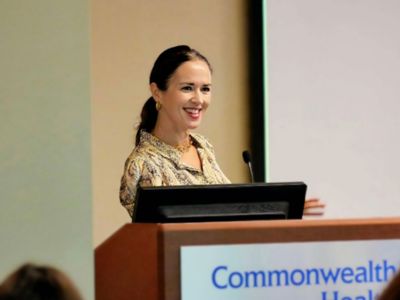 Pennsylvania State Representative Bridget Kosierowski, who represents Lackawanna County, emphasized the connection between healthcare and the overall strength of a community, noting that access to high-quality healthcare is fundamental to making a region a place where people want to live, work and raise families. Ultimately, she stressed, a community’s health and healthcare access is among its most important assets.
A Cost-Effective, Scalable Approach
An independent analysis by Tripp Umbach found that the NEPA-CEC provides a cost-effective alternative to developing an entirely new medical school. By leveraging existing accredited osteopathic medical schools and local clinical capacity, the consortium can expand physician training without the significant capital investment required to establish a new institution.
The consortium was established with Lackawanna College serving as a neutral convening organization, aligning the resources of osteopathic medical schools with hospitals, community health centers and other clinical partners throughout Northeast Pennsylvania. The model is intended to connect undergraduate medical education, graduate medical education and eventual entry into practice, creating a more coordinated regional physician workforce pipeline.
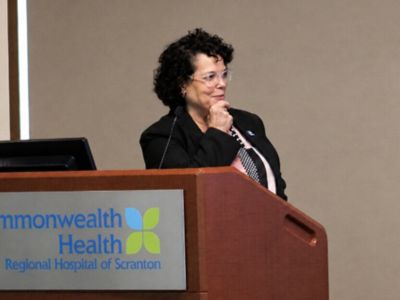 “Healthcare is for everyone, and strengthening it takes all of us working together,” said Jill Murray, PhD, president of Lackawanna College. “What we have accomplished through the NEPA-CEC shows just how successful this kind of collaboration can be. By bringing together education, healthcare and community partners around a shared purpose, we are creating opportunities for future physicians while building a stronger, healthier Northeast Pennsylvania.”
For David Karpe, a third-year medical student at the University of New England College of Osteopathic Medicine currently completing clinical rotations in Scranton, the impact of that collaboration is already deeply personal. Karpe told attendees that his experience training in the region has made him fall in love with Scranton and that he and his wife now plan to move to Northeast Pennsylvania to raise their family, nothing the experience has shown him that the region is a place where he can make a meaningful impact as a physician.
Karpe’s experience illustrates one of the consortium’s central goals: introducing future physicians to the communities that need them most and creating opportunities for those students to build lasting personal and professional connections to the region.
Taking the Scranton Model Nationwide
 The event also highlighted the bipartisan Community Training, Education, and Access for Medical Students (Community TEAMS) Act, federal legislation supported by AACOM that would establish a Health Resources and Services Administration grant program to expand medical student clinical rotations through partnerships among medical schools, Federally Qualified Health Centers, Rural Health Clinics and other healthcare facilities in medically underserved communities.
The legislation reflects the same principle driving the NEPA-CEC: communities do not necessarily need to build entirely new institutions to expand physician training. By investing in partnerships and existing healthcare infrastructure, they can create additional clinical education opportunities where they are needed most.
“The NEPA-CEC is about more than adding clinical rotations,” Speicher said. “It is about connecting medical education to the health and workforce needs of a community. If we can train more students in communities like Scranton, connect them with local physicians and health systems and create a pathway that encourages them to stay, we can strengthen both medical education and access to care. That is an approach worth replicating.”
The NEPA-CEC is entering its second year as partners continue to expand the consortium and evaluate its impact on students, healthcare organizations, patients and the regional physician workforce.
Photos courtesy of Lackawanna College.
About AACOM:
Founded in 1898, the American Association of Colleges of Osteopathic Medicine (AACOM) is the leading voice for the education and training of physicians who practice osteopathic medicine in settings across the medical spectrum—from primary care to the full range of medical specialties. We support our member colleges of osteopathic medicine in their efforts to attract and train individuals who are fueled by a desire to make a difference in our healthcare system by treating the whole person and building a future emphasizing health and wellness for all people. Today, more than 38,000 future physicians—close to 30 percent of all U.S. medical students—are being educated at one of our 48 accredited colleges of osteopathic medicine, encompassing 75 teaching locations in 36 states. To learn more about AACOM, please visit our website.
Contacts:
Joseph Shapiro
Director of Media Relations
(240) 938-0746
jshapiro@aacom.org
Christine DeCarlo
Senior Manager of Media and Public Affairs
(202) 603-1026
cdecarlo@aacom.org