
Seeing the Whole Patient: How GlaucoCheck is Leveraging the ClinEd Accelerator to Bring Clinical Judgment to an AI Era
Published October 30, 2026
On medical mission trips to Central America and Central Asia, Julia Agapov, DO, MD, continually encountered a challenge that extended beyond the availability of treatment. Glaucoma expertise was difficult to reach for her patients, particularly in rural areas, and the information needed to understand their disease could be scattered across years of test results.
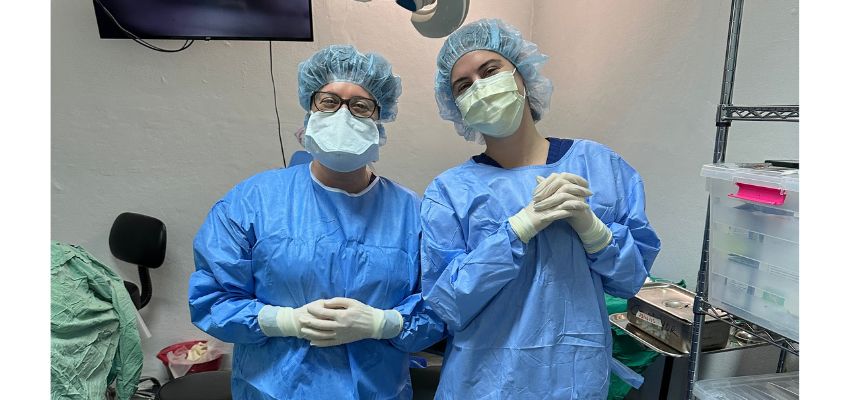 Caption: Premedical student Sophia Agapov (right) assists Dr. Julia Agapov (left) during cataract surgery at San Felipe Hospital in Honduras.
"Glaucoma can progress quietly because patients may not be aware of the peripheral vision loss until the disease is really advanced," said Dr. Agapov, a fellowship-trained glaucoma specialist and regional medical director at SSM Health in Wisconsin.
Dr. Agapov recognized that familiar problem in smaller communities in the United States, too. When specialist access is limited, gathering evidence and connecting a patient with medical experts who can interpret it becomes an essential part of care. In the case of glaucoma care, the disease damages the optic nerve and often progresses without noticeable symptoms, making routine eye evaluations essential for detecting changes and guiding treatment.
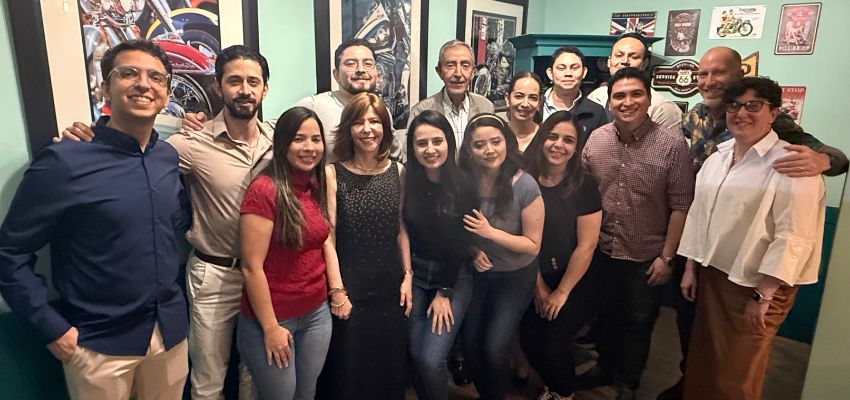 Caption: Drs. Julia Agapov, Tim Harvey and Patricia Sierra, members of Eye Surgical Allies, with fellow volunteers and local ophthalmology residents during a surgical mission in Tegucigalpa, Honduras. The team performed more than 80 eye surgeries and provided hands-on surgical training and mentorship.
"Clinicians have to bring together eye pressure, optic nerve structure, visual fields, treatment history and changes across multiple visits. It's recognizing [those] meaningful change[s] over time while considering test quality and the full clinical context. That takes time and expertise,” Dr. Agapov explained.
The stakes for patients are high. Of the three million Americans living with glaucoma, half don't know they have it. Access to preventive care can help patients preserve their vision before it causes blindness, if they can access it. Specialty care has become more challenging for rural residents to reach. From 2010-2021, a growing number of communities became ‘dead zones’ for specialty eye care, increasing geographic health disparities.
Innovation for Students, Supported by AACOM's Accelerator
That gap between community health needs and accessible ophthalmological care is what drove Dr. Agapov and her team, Anya Nesterchouk, PhD, who serves as curriculum expert, Sophia Agapov, who provides a premedical student perspective, and Victor Agapov, who offers technical and prototype support, to create GlaucoCheck, an AI-assisted clinical decision-support and education tool.
The team brought their innovative idea to AACOM's ClinEd Accelerator, a six-week virtual challenge designed to improve bottlenecks in clinical training, to make complex glaucoma information easier to access, especially in places where specialists are not readily available.
When fully developed, GlaucoCheck will bring together reports from different patient visits, devices and years. It will leverage artificial intelligence (AI) to help healthcare professionals review eye pressure, images of the optic nerve, visual field tests and treatment history.
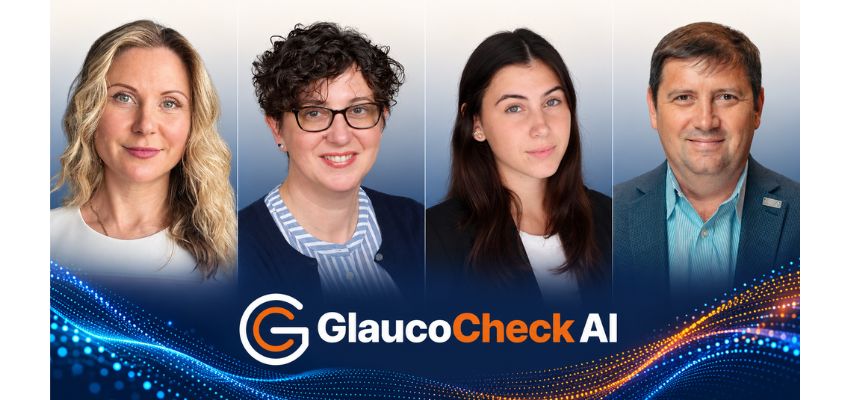 Caption: The GlaucoCheck team. From left to right: Dr. Nesterchouk, Dr. Agapov, Sophia and Victor.
The team envisions creating a platform where physicians, nurses and technicians can all see the same view of a patient's vision changes over time, gather the scattered data and documentation from across a patient’s medical history and even allow a glaucoma specialist to review the case remotely instead of asking the patient to travel.
To support medical students, who often have too little time in a narrow specialty like ophthalmology to learn complex cases, the team developed a separate educational mode that helps learners interpret evidence and critically evaluate AI.
Learners will be able to increase their knowledge by reviewing simulated glaucoma cases and engaging with AI-generated responses through the GlaucoCheck platform. Most importantly, the tool will allow clinical decisions to remain with the healthcare professional.
The team’s innovative idea competed in the Accelerator's "DOs as the Human Interface in AI-Enabled Care" track, which asks teams to define the physician's role alongside AI and critically evaluate AI analysis.
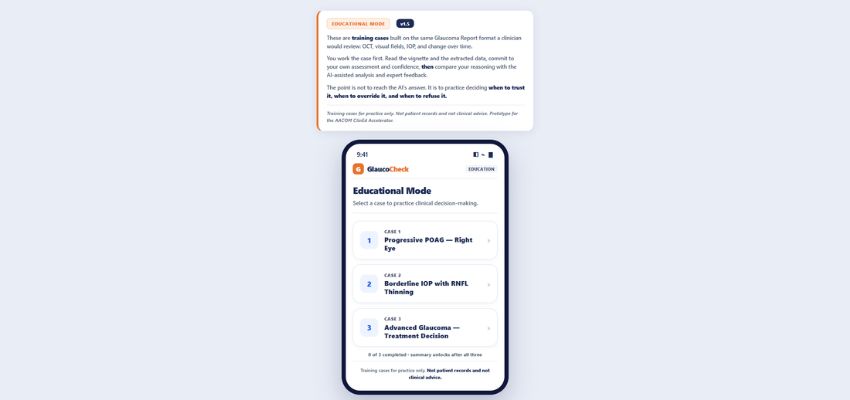 Caption: A simulated view of the GlaucoCheck Educational Mode.
The project addresses two connected training needs: Opportunities to work through specialty cases when clinical exposure is limited and structured practice evaluating AI to advance better patient care.
Human First, AI Second
Today, physicians need a strong clinical foundation to assess what an AI system produces, identify what is missing and decide whether its conclusion makes sense for their patients.
GlaucoCheck's unique educational approach asks learners to think through the case before seeing the AI’s response. Only after they critique it does the platform provide the expert feedback and explain the reasoning behind the conclusion.
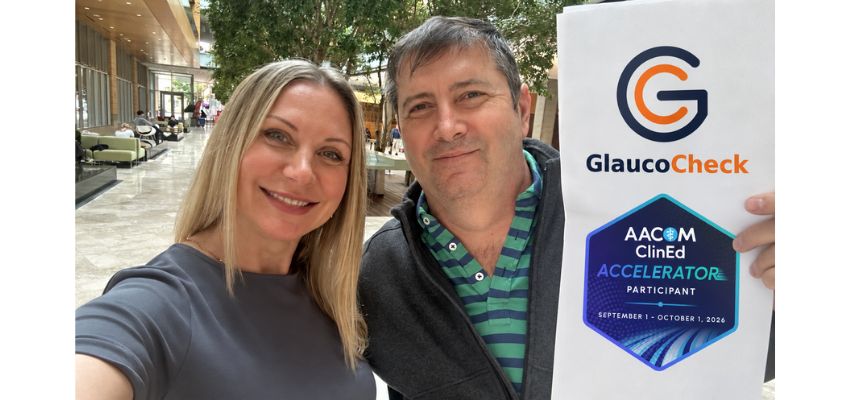 Caption: Dr. Nesterchouk and Victor posing with the ClinED Accelerator participant badge.
"For this accelerator, I proposed an educational model built around a three-step learning loop," Dr. Nesterchouk explained how GlaucoCheck helps learners build critical thinking and clinical reasoning skills.
Learners first review a case, choose a management step and rate their confidence. Only after committing to an assessment do they see the AI-assisted analysis. They then decide whether they agree, partially agree or disagree, and explain why. Students have to make their uncertainty visible before an AI answer can shape their thinking. Then, they must then consider whether the AI has overlooked context, overstated a conclusion or failed to account for the quality of the evidence.
“The goal here is reflection and better judgment, not simply revealing the correct answer,” shared Dr. Nesterchouk.
Both Sophia and Dr. Nesterchouk noted that students are already using AI without enough structured opportunities to question and verify its output. GlaucoCheck is intended to make that scrutiny part of learning. "Students [must] question AI output and recognize the limits of an algorithm while strengthening their clinical judgment. They [ultimately] need to remain responsible for the final decision," Dr. Nesterchouk said.
The team explained how useful this model could be if integrated into clinical training pathways. Studying cases through GlaucoCheck can give students a stronger starting point for conversations with preceptors. Learners who have already worked through a case arrive with a higher baseline, Dr. Nesterchouk shared, so discussion can move past right or wrong, allowing more time for clinical nuance and the reasoning behind a decision.
The Whole Patient, Not a Data Point
For Dr. Agapov, GlaucoCheck's design reflects osteopathic medicine's founding philosophy that physicians must treat the whole person.
In one simulated case in the public demo, learners' juggle case notes that their patient often forgets to use their eyedrops in the evening alongside the changes in their imaging, visual field results and eye pressure. Each data point and patient note paints a larger picture that includes a patient’s history, symptoms, behaviors and overall health.
In the GlaucoCheck platform, requiring learners to explain their clinical decisions creates space for their patient's behaviors and lifestyle to enter care delivery. Dr. Nesterchouk shared that moment when a student puts their reasoning into words, "is when the human side of care becomes visible."
From Prototype to Pilot
The GlaucoCheck team came to the ClinEd Accelerator to develop their educational prototype and obtain feedback to improve their idea.
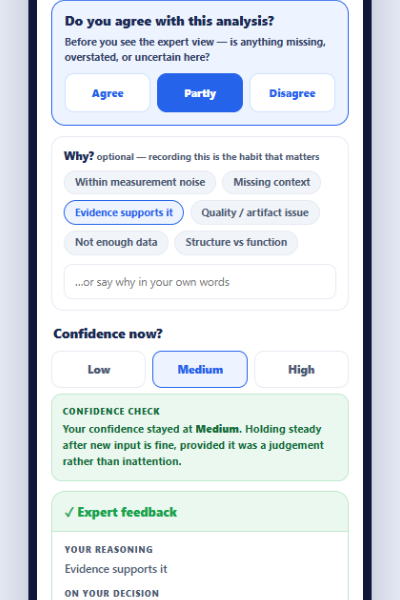
Caption: A simulated view of the GlaucoCheck platform.
"This is still a prototype of an educational model, so we are not claiming that its effectiveness has already been proven or that the application has been fully validated," Dr. Nesterchouk said. "We are presenting an idea grounded in established learning principles and seeking feedback from the accelerator experts."
If the model proves to be useful, the team hopes to expand the case library and move into other ophthalmological specialties. With the training sequence of independent assessment, critical review of AI and feedback that explains the reasoning, the team also envisions larger scaling to other medical fields that also require clinicians to interpret large amounts of diagnostic information.
For AACOM, GlaucoCheck is a concrete example of what the ClinEd Accelerator was designed to encourage: The people closest to a clinical or educational problem shaping the response and building a path forward.
As the team advances their work, Dr. Agapov hopes users will make better-informed clinical decisions, become more confident learners and gain specialist-level insight. Above all, the team is working to bring medical expertise to the places that need it most, including rural clinics like the ones where the idea began.

Dr. Julia Agapov is a fellowship-trained glaucoma and cataract surgeon and Regional Medical Director of Ophthalmology at SSM Health in Wisconsin. She earned her DO degree from the New York College of Osteopathic Medicine and her MD degree from Russian State Medical University in Moscow. She completed her ophthalmology residency at Metro Health Hospital/Michigan State University and a glaucoma fellowship at Indiana University in 2007. Currently President-Elect of the American Osteopathic Colleges of Ophthalmology and Otolaryngology–Head and Neck Surgery (AOCOO-HNS), Dr. Agapov is involved in clinical research, medical education and international surgical outreach. She founded GlaucoCheck to explore how AI can improve access to glaucoma expertise while keeping clinical judgment in the hands of healthcare professionals. She co-founded JAGS International, which brings together her international glaucoma education, surgical training, and outreach efforts.
Anya Nesterchouk is an experienced educator and program director at the University of Wisconsin–Madison, with more than 25 years of experience in education. She holds two master's degrees in world language education and a PhD in Curriculum and Instruction. Her expertise includes curriculum and program design, teacher training, mentoring and international language education. As a member of the GlaucoCheck team, she leads the educational design of its learning model, helping students develop clinical reasoning and critical thinking skills when evaluating AI-generated information.

Sophia Agapov is a premedical student at the University of Miami with an interest in ophthalmology, clinical research and medical education. She has participated in three ophthalmic surgical missions to Honduras, gaining hands-on exposure to patient care and surgical procedures. She has also been involved in ophthalmology research at Bascom Palmer Eye Institute. As a member of the GlaucoCheck team, Sophia contributes the student perspective to the development of its educational mode, helping shape a learning experience for future physicians.
Victor Agapov is a technology professional with a background in information technology, systems administration and business management. He is a founding member of the Disability:IN Wisconsin Board of Advisors, supporting workplace inclusion. As a member of the GlaucoCheck team, he provides technical expertise and supports the development of its digital prototypes.