
Cultura Cura: Why Representation in Osteopathic Medicine Heals
Published September 23, 2026
Inside OME
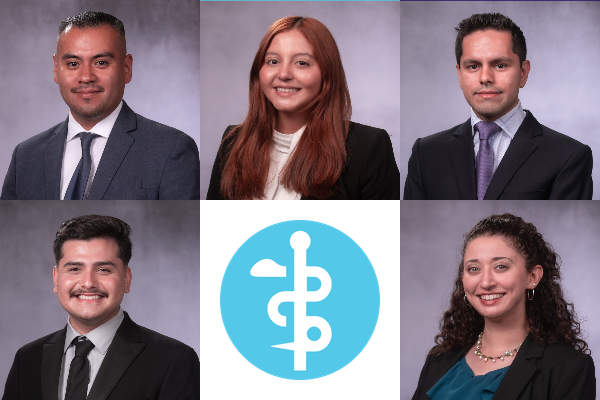
By the California Health Sciences University College of Osteopathic Medicine Latino Medical Student Association Board. Pictured from left to right, first row: Edward Elizarraras; Esmeralda Menjivar; Carlos Gonzales Melgar; Emmanuel Martinez-Cortez; Tatiana Becerra.
We write this as Latina/o/x osteopathic medical students, the hijos and nietos of immigrants, farmworkers and families who taught us that caring for others begins at home. For us, the members of the Latino Medical Student Association (LMSA) at California Health Sciences University College of Osteopathic Medicine (CHSU-COM), National Hispanic Heritage Month is personal. It is a reminder of a truth we have lived long before we put on the white coat: culture can be a form of care, and our heritage is a source of strength in the exam room and in the community alike.
Many of us know the healthcare gap because we grew up within it: we were the kids who interpreted for our parents in waiting rooms, who watched an abuelo or a tío struggle to explain their pain to a doctor who could not understand them. The numbers confirm what we felt: although Latinos make up nearly one in five people in the United States and roughly 40 percent of California's population, only about six percent of U.S. physicians identify as Hispanic or Latino. In the Central Valley, where so many of our patients are Spanish-speaking farmworkers and immigrant families, that gap is felt every single day.
Osteopathic medicine is uniquely positioned to close that gap, and part of why we chose it is that its philosophy already sounds like home. It treats the whole person — body, mind, and spirit — in the context of their family, community and environment. That is what nuestras familias have always taught us: that healing happens in relationship, that dignity matters and that a person's story is inseparable from their health. When osteopathic training embraces cultural humility and linguistic competence, it becomes a powerful vehicle for the community-centered care our gente deserve.
At CHSU-COM, we try to live that mission year-round. This year we reinstated a Medical Spanish Chair on our board, a leadership role dedicated to helping our classmates build the language skills that let them connect with Spanish-speaking patients through study guides and review sessions. We are hosting a National Latino Physician Day event that brings local Latina/o/x physicians together with our medical students and high schoolers from the community, so the next generation can see themselves in this profession. We partner with organizations such as MiMentor and local clinics to build a pipeline that reaches back to pre-health students who share our roots. And we honor tradition, too — a community Día de los Muertos ofrenda, and the languages, foods and familias that made us who we are.
These efforts are not extracurricular; they are central to who we are as future physicians. Representation is not simply about who wears the white coat. It is about a Spanish-speaking grandmother finally understanding her diagnosis in her own language. It is about a first-generation student realizing that a career in medicine is within reach. It is about physicians who carry their patients' languages, values and lived experiences into every encounter — and who, because of that, earn a trust that makes healing possible.
We have seen what that trust makes possible, because we have lived it on both sides of the exam table. A patient who once nodded along without truly understanding will finally ask the question that changes their care. A family that avoided the clinic for years will return for follow-up because someone met them with respect and in their own language. These moments are quiet, but they are the difference between medicine that is merely delivered and medicine that is actually received, and they happen far more often when a physician shares, or has taken the time to learn, a patient's language and culture.
Hispanic Heritage Month gives us a moment to honor the generations who came before us: the padres and abuelos who sacrificed so that we could pursue this path, and the community leaders and physicians who opened doors we now hold open for others. As Latina/o/x osteopathic medical students, we carry both the opportunity and the responsibility to strengthen the pipeline behind us, to advocate for equitable care and to make sure our profession reflects the communities it serves.
Cultura cura — culture heals. Our heritage is not something we set aside when we put on the white coat; it is one of the greatest tools we bring to the bedside. This month, and every month, we celebrate that truth, and we recommit to building a more representative and more compassionate future for osteopathic medicine.
To our fellow students, faculty and colleagues across the osteopathic community: celebrate with us, support the Latina/o/x students on your campuses and remember that when our profession reflects our patients, everyone heals a little better. Sí se puede.