
Growing a Culture of Creativity in Medicine
Published October 05, 2026
Research Stories Research Stories Report Page
At first glance, Sarah Adkins’s, DO, PhD, career might seem unconventional: professional artist-slash-microbiology researcher turned physician-scientist training at Walter Reed and Uniformed Services University. But for Dr. Adkins, creativity is the common thread that ties her career together. “Art trained how I think and how I look and approach problems,” she reflected.
“And I think a lot of those same habits have [been] translated into how I operate as a researcher and physician. Both disciplines, [art and microbiology], have shaped how I think, and I knew I wanted to bring that curiosity to caring for people,” Dr. Adkins said.
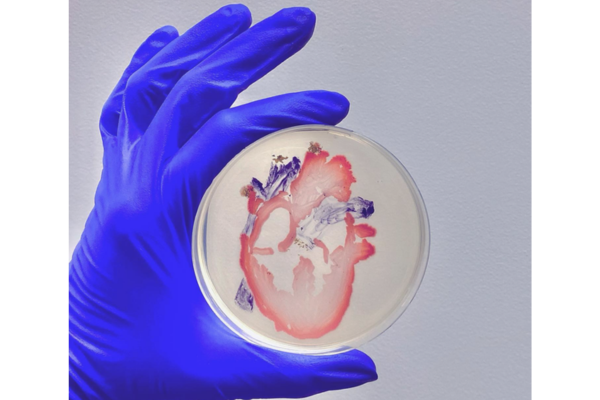
Dr. Adkins holding up agar artwork that resembles an anatomical heart.
Dr. Adkins is part of the growing number of osteopathic physicians, accounting for nearly 11 percent of U.S. doctors today, who are bringing fresh perspectives and a passion for holistic care to modern medicine.
Art as Science
Dr. Adkins’s early experiences as an artist helped her understand the role creativity plays in bolstering scientific thinking. As an undergraduate, she recalled replacing a traditional microbiology essay with a hand-drawn graphic novel—not sure how it would be received but confident it was the best way for her to showcase her understanding of the content.
That risk paid off. Not only did her creative approach earn her top marks, but it also unlocked the door to her first research position.
“[For me, that experience] is also a microcosm of a bigger story: being able to communicate through the visual arts and understanding how to solve a problem from a different perspective. And that is what I learned to do as an artist,” Dr. Adkins shared.
Innovation emerges from unexpected approaches—an ethos Dr. Adkins carried into her doctoral work in microbiology and medical education, where she helped reform undergraduate biology curricula and secured grant funding through unconventional thinking.
![Dr. Adkins' agar art created from kombucha [and soil bacteria] and in the shape of a cluster of leaves, which is the Harvest Roots Ferments logo.](https://www.aacom.org/images/default-source/research-report/dr-adkins'-agar-art-created-from-kombucha-and-soil-bacteria-and-in-the-shape-of-a-cluster-of-leaves-which-is-the-harvest-roots-ferments-logo.png?sfvrsn=f2ac6cb5_1)
Dr. Adkins' agar art created from kombucha [and soil bacteria] and in the shape of a cluster of leaves, which is the Harvest Roots Ferments logo.
“Wrestling with what I know and what we think we know; that type of thinking, I would argue, is very important in medicine. It's hard to imagine myself now as a doctor without the background that I have [in art],” Dr. Adkins reflected.
Art and medicine stopped being separate disciplines, rather becoming complementary practices in Dr. Adkins’s eyes. Both demand empathy and a willingness to grapple with uncertainty. Both require practitioners to interpret incomplete information and arrive at meaningful conclusions.
Philosophy of Whole-Person Care
Dr. Adkins’s interest in osteopathic medicine helped sharpen this viewpoint. Unlike traditional models centered primarily on disease, osteopathic philosophy emphasizes the interconnectedness of the body, mind and spirit.
For Dr. Adkins, this approach resonated deeply with her own life experience. While in medical school, she became the primary caregiver for her mother, overcoming barriers like insurance coverage and access to care alongside the demanding schedule required of medical training. That experience, she said, transformed abstract lessons about social determinants of health into lived reality. “I was concurrently navigating medical school and becoming the caregiver for my mom in rural Alabama. In real time, I understood a lot of the things we talked about in medical school,” Dr. Adkins shared.
“I’m coming from a family where neither of my parents have bachelor’s degrees, from a family with a lower income. So, I already understood how social determinants impact health. These patients and families are very, very real to me when I’m thinking about access to healthcare,” Dr. Adkins said and explained how few medical students come to medicine with backgrounds and experiences like hers.
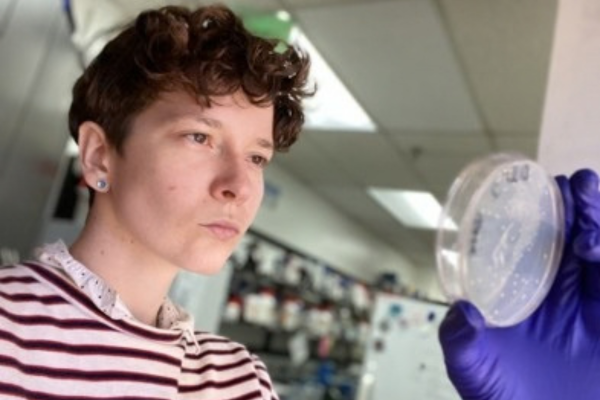
Dr. Adkins examining a petri dish in a lab setting.
Dr. Adkins knew she wanted to be the type of physician who thinks simultaneously about individual patients and the systems that shape their outcomes.
"My medical education, specifically at a DO school and alongside some of my personal experiences, has helped me become very aware of inequities and social determinants of health,” Dr. Adkins reflected. “And I do think that osteopathic physicians are uniquely prepared to act as change agents and improve health systems and patients' quality of life. I think those values are incredibly important if we want healthcare to work for people,” she said.
Fighting a Silent Threat
Dr. Adkins’s commitment to improving lives is particularly visible in her work on antibiotic stewardship research at the National Capital Consortium, working collaboratively with Walter Reed National Military Medical Center and the Uniformed Services University of the Health Sciences. “[My work] marries a lot of my interests in microbial science, but also my passions for understanding curricula, students, change and education,” Dr. Adkins said.
Antibiotic misuse, she explained, is one of the most pressing—and often overlooked—threats in modern medicine. Inappropriate prescribing contributes to antibiotic resistance, increasing the risk of so-called “superbugs” that can evade treatment and jeopardize patient safety worldwide.
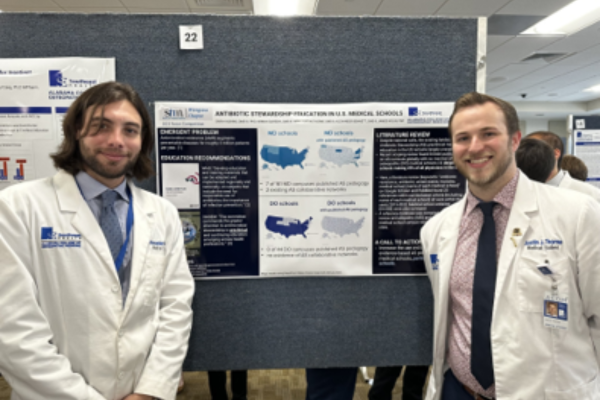
At ACOM's Research Day, Dr. Adkins' co-investigators pose with their poster on antimicrobial stewardship (Left: Alex Bennett, DO, PGY-1 in General Surgery at University of South Florida, Tampa, FL, and Right: Justin Thorne DO, PGY-1 in General Surgery at West Virginia University, Morgantown, WV.)
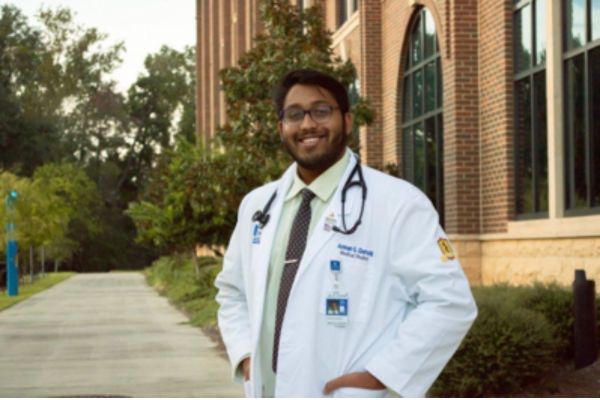
Arman Qureshi, MPH, DO, PGY-2 in Family Medicine at Bayfront Family Medicine, St. Petersburg, FL, served as a co-investigator on Dr. Adkins' antimicrobial stewardship work, which won an AACOM Research Grant in 2025.
Rather than focusing solely on clinical behavior, Dr. Adkins and her colleagues are examining how physicians are trained to understand and use antibiotics. Their research, which earned an AACOM Research Grant in 2025, explores gaps in medical curricula—what is taught, what is omitted and how those gaps may influence prescribing practices. “I am a firm believer that good education leads to good doctors, and good doctors leads to good patient care,” said Dr. Adkins shedding light on the approach behind her work.
Dr. Adkins’s research involves analyzing educational materials, interviewing faculty and mapping how different institutions approach antibiotic training. But its implications are vast: Better education today could prevent resistant infections tomorrow, improving care across entire populations.
“I think that big picture perspective is what appeals to me so much—thinking about population-level questions with individual answers,” Dr. Adkins said.
Expanding the Pipeline
In addition to bringing new knowledge to the practice of medicine, Dr. Adkins also works to broaden access to research opportunities for future physicians. She has mentored students, helped build student research programs and encouraged osteopathic trainees to see themselves as both physicians and scientists.
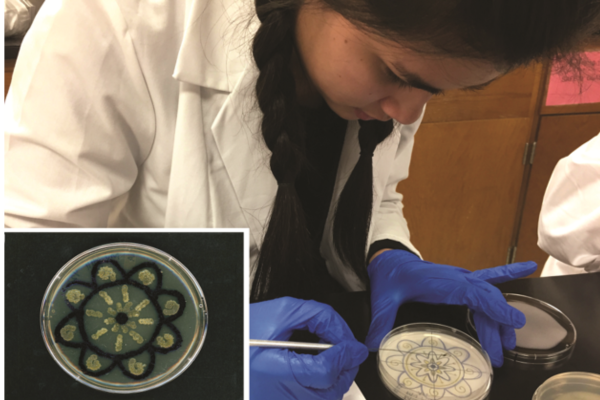
A UAB student and her agar art consisting of two colorful soil microbes shaped in a “mandala” she designed.
“Research experiences shape how doctors think about problems and evidence, and how to apply that evidence to your patients, ultimately shaping guidelines that we apply to practice,” Dr. Adkins shared.
She believes research from an osteopathic point of view adds an essential and missing perspective to the broader medical evidence base. “DOs represent close to 30 percent of all future doctors,” Dr. Adkins noted, “and osteopathic medicine has something very valuable to offer some of [today's health] problems, because of its emphasis on prevention, primary care. We should also be producing evidence that guides medicine and improves systems.”
Dr. Adkins envisions a healthcare system that prioritizes prevention and shapes care based on understanding patients’ lives and high-quality evidence. She is energized by the opportunity to expand the horizons of her work so far, mentorship, research, education and osteopathic medical practice, to improve healthcare while keeping sight of each patient.
“A lot of my interests continue to overlap. Preventive medicine feels like a natural continuation of a lot of what I’ve already been doing and improves care for many people at one time,” Dr. Adkins said.
Guided by her creativity—the willingness to look at things differently and take unconventional pathways—Dr. Adkins is helping shape a healthier future for all.
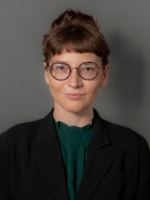
Sarah J. Adkins is a physician-scientist and U.S. Navy Officer, currently in residency training in General Preventive Medicine through the National Capital Consortium. Adkins earned her BA in Art, BS in Biology and PhD in Biology at the University of Alabama at Birmingham prior to earning her DO degree at the Alabama College of Osteopathic Medicine. She is currently earning her MPH&TM at the Uniformed Services University of the Health Sciences. In 2023, Adkins was awarded AACOM National Student Researcher of the Year, reflecting a longstanding passion for making research accessible to the next generation of doctors. You can find her posting her science art on Instagram and her thoughts on medicine and science on X at @AdmiralAdkins.
The views and opinions presented herein are those of the author and do not necessarily represent the views of DoD/DoW or its Components
Spread the word!
- What do art, microbiology and osteopathic medicine have in common? For Sarah Adkins, DO, PhD, creativity is the line that connects how she approaches research, patient care and medical education. Learn more about her perspective as an artist and physician.
- Sarah Adkins, DO, PhD, is using creativity and osteopathic principles to tackle antibiotic stewardship, expand research opportunities and strengthen whole-person care. Learn how her unconventional path is helping shape health and medicine.
- Sarah Adkins, DO, PhD, has built a career at the intersection of art, microbiology and osteopathic medicine. In this new feature story, she shares how creativity shaped her path as a physician-scientist and how her work in antibiotic stewardship, research mentorship and whole-person care is helping advance osteopathic medicine. Learn more about Dr. Adkins’s perspective.
- From professional artist to microbiology researcher to osteopathic physician-scientist, Sarah Adkins, DO, PhD, has followed an unconventional path grounded in curiosity and creativity. Her story highlights the value of bringing fresh perspectives to medicine, from improving antibiotic education to expanding the pipeline of future physician-scientists. Check out her story!